— Why did a little girl laugh with a face on the verge of tears at the first summer ice she ever tasted? —
Heian-kyō, 1000 (Chōhō 2) · 8 min read
New here? Why the narrator has been wandering for a thousand years is told in the Prologue.
Nowadays nobody is surprised to eat ice in summer. I buy a cup of shaved ice at the convenience store myself, and grab rock ice out of the freezer. If it melts, I don't mind. You just freeze it again.
But since when, exactly, have people been able to eat ice in summer? How did anyone keep, all the way into summer, something that can only be made in winter?
I once touched the edge of the answer, just one time.
In the summer of 1000 (Chōhō 2), in the hill country that spreads north of Heian-kyō, I was hired for a single night as a porter to carry ice.
The man who called out to me seemed to be a keeper of an himuro, an ice house, gathering carriers from the villages because he was short of hands. The job was to deliver ice to the mansion of a certain kandachime, a senior noble of the court. For someone who got by on rice for a night's work, the name of the place and the face of the recipient hardly mattered. At dusk we met at the mouth of the mountain, and there were three men I had never seen, each come from a different village. They were of all ages, the kind of faces you would never meet again. Someone handed round water and a little dried rice. We chewed on it and waited until the night was well along.
Past midnight we were led to a deep pit dug into the north side of the mountain, on a slope the sun never reached. Thick layers of kaya reed and leaves had been laid over it, with earth heaped on top. The thickness of the covering told me it was meant to see out the whole summer. Down inside, no matter how scorched it was outside, the chill went straight to the bone. At the bottom of the damp dark, with its smell of earth, the ice lay sleeping. It had been cut in winter, and ever since it had waited for summer in this darkness.
We cleared the earth with hoes and peeled back the reeds. No one spoke; only the sound of digging echoed in the dark. The ice that came up from below was as big as the covering was thick. Four blocks, each about an armful, were wrapped in mushiro, straw matting, and roped for carrying. There were four carriers, myself included. We were to go down the mountain in the middle of the night and enter the capital before it was fully light. When I set the rope on my shoulder, it was heavier than I had expected. My body remembered how much ice can weigh. The rope bit into the same spot on my shoulder.
We walked without stopping. The one time we rested was at the foot of the mountain, and even then we only stood with the loads on our backs and caught our breath. With only the moon for light, we picked our way over a stony road. One slip and we might have gone into the valley along with what we carried. Little by little, on the way, the weight of the rope on my shoulder grew lighter. Every corner of the block had melted round without my noticing, and drops fell, pota, pota, from the gaps in the matting. Even as we carried it, the ice was turning its own body into water and leaving it behind on the road. Before daybreak, everyone hurried in silence. I never learned the names of the other three; we simply shared the same weight through one night. By the time we reached the gate, fully half of what had left the mountain was lost.
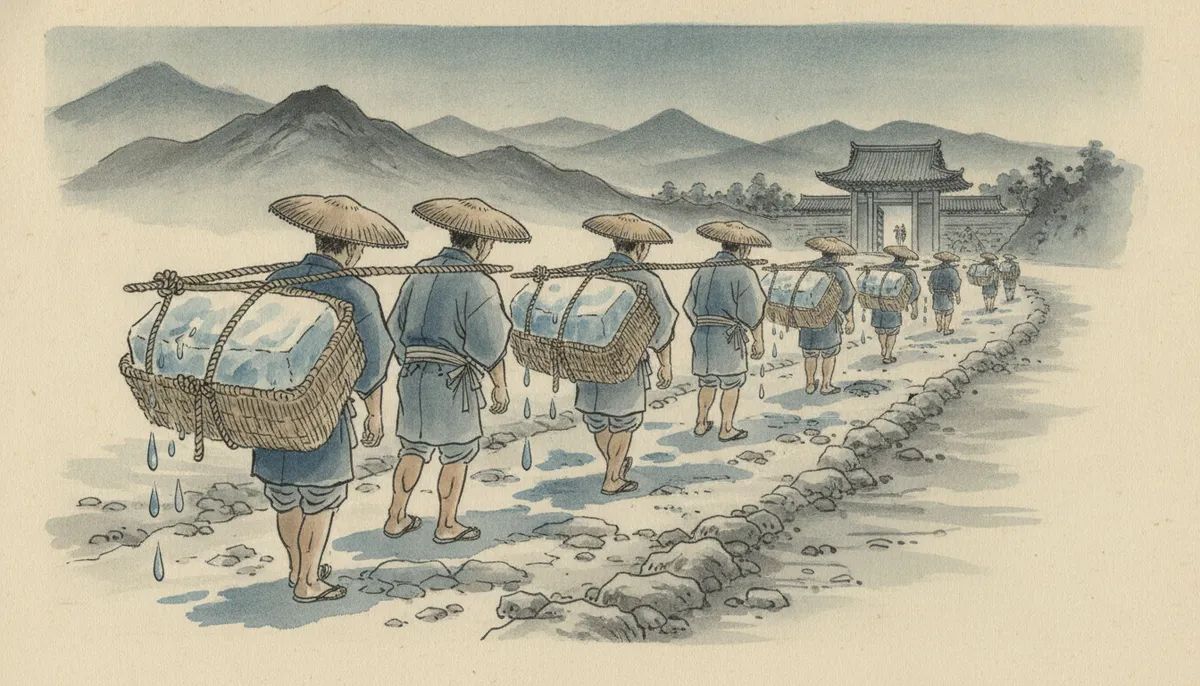
Before the gate we undid the ropes and shifted the matting into our arms. The capital had already been steaming since dawn. Dogs lay stretched out under the eaves with their tongues hanging. Even the well water was tepid, and the sweat poured out however much you wiped it. Even so, the matting in my arms alone stayed cool to the touch.
At the gate it was a woman from the household, a servant, who received the ice. With practiced hands she checked the edge of the matting and let it rest on her arms as if weighing it. Seeing how much lighter it had become, she showed no surprise at all. It must have happened every year. We handed over the blocks, matting and all, took our payment of rice, and that was the end of the work. We were not allowed to go any farther, into the mansion. I leaned my back against the gate post and caught my breath for a while.
While I waited for the payment, over the wall came the sound of a blade shaving ice, shari, shari. At first short, then long, the blade slid along the face of the ice. I could not see inside the gate. Even so, the sound told me where that block had ended up.
After a while a sweet smell came drifting over the wall in a single thread. Something to go with the ice, I supposed. For a moment that sweetness pushed aside the smell of earth soaked into the matting.
A woman of the household beside me said quietly to her companion that they would offer the young lady something cool again today. Another voice from inside the wall joined in, hurrying: it melts as fast as it is shaved, so bring it quickly.
Beside the gate a little girl, a water-carrier, was staggering along holding a small tarai, a basin, full of water. She might have been five or six. She must have made the trip between the well and the gate many times over, for her steps did not waver. On her thin arms I could see fingertips cracked from water work. A piece the size of a clenched fist, which had rolled out as we unwrapped the matting, was lying on the ground. No one looked at it. Chipped and dirty, that one piece would never reach the young lady's mouth. It was ice fit only to be thrown away.
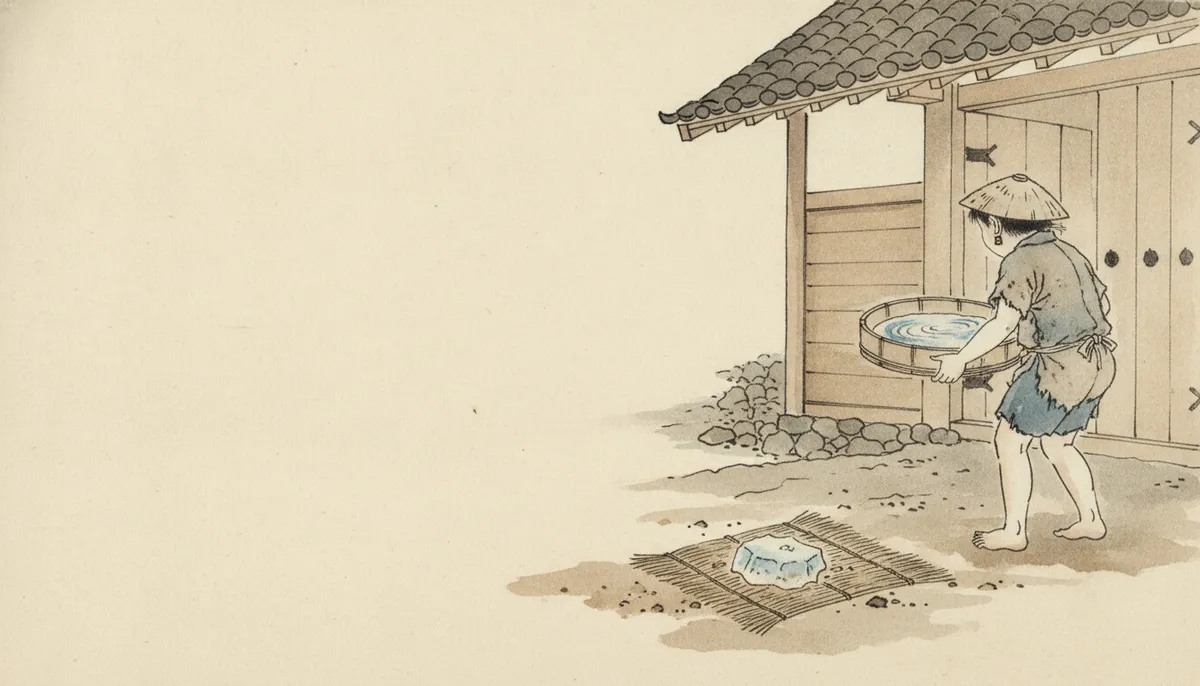
I picked it up and brushed off the dirt with my sleeve. It was already half water, but it was still truly cold. Across its surface ran many fine lines, made by a hoe or a blade, I could not tell which. Someone called out, "Ako!" to the girl. It was the first time I had heard her name.
I set that ice in Ako's small palm.
Ako's eyes went round, and she stared at it. In the hollow of her hand, tiny drops had begun to gather. Then, fearfully, she touched it with the tip of her tongue: tsun.
At once Ako's shoulders jumped. In the midst of all that heat, the chill was rising up from her palm. She drew a sharp breath, hi, but she would not pull her hand away. Once more, and this time she set it properly on her tongue.
Ako's face crumpled. I thought she would cry. She did not. With a look I cannot name, on the verge of tears yet unbearably glad, Ako laughed.
"It's cold... it's so cold."
It was all she could say, and she said it again and again. The ice in her palm had mostly turned to water already and was running away between her fingers. Ako, grudging even the last drop, licked it up. And still, reluctant to let go, she went on gazing at her wet palm, as if to make sure that the thing which had just vanished had really been in this world.
"Hey, where does this come from?"
Ako asked it in a small voice. There is a cold place deep in the mountains that doesn't melt even in summer, I told her, and Ako's mouth fell half open, and her eyes took on the look of picturing some far mountain. Ice sleeping in the dark at the bottom of a valley must have sounded to this child like something out of a dream. She seemed to want to hear more, but I told her nothing further.
"Hey, the rice has come out!"
My fellow carrier called me, and that was all. Ako stood holding her basin, looking my way. She did not wave or call after me. She only looked. I never heard Ako's name again, nor the name of that mansion. I left the gate on the spot and went off to look for the next job.
In those days, they say, sugar was not yet something that entered just anyone's mouth in this country. What went with the ice was amazura, it seems, the sap of a vine boiled down. In The Pillow Book, ice shaved and dressed with it and heaped in a new metal bowl is counted among the elegant things.
Today, to freeze a single piece of ice, the flick of a machine's switch is enough. No hands are needed, and no road through the night.
The ones who carried the ice that night were four, myself included. From the time we left the ice house at midnight until we reached the gate at dawn, it passed across the shoulders of four men. Where it ended up was a coolness for someone behind a wall, someone I would never see.
What landed in Ako's palm was one fragment that had fallen away. Cut in winter, half a year old, carried all night, it took about as long to vanish as it takes to count slowly to a hundred.
Bring your nose close to the syrup on today's shaved ice, and it always smells the same sweet smell. What lingered on Ako's wet palm that morning was the smell of straw matting and damp earth.
Every tale is built on real scholarship. These are the Japanese-language works this one rests on — listed in full, so you can see exactly where the history ends and the story begins.
New tales are translated as they are written. Get each one — with a short note on the history behind it — by email.
 The Tales Only I Have Seen