— Why was the lighter stick dearer than the heavier one? —
Tosa, 1850 (Kaei 3) · 8 min read
New here? Why the narrator has been wandering for a thousand years is told in the Prologue.
"The first one, I can hand over right now. The second, tomorrow noon. The third will take ten days or so."
Beyond the soot-darkened shaving block, the master set his blade down on the board and told me so. If the first stick cost one, the second cost one and a half, and the third twice that. His voice was low and flat. His fingers were bent in the shape of a lifetime spent gripping dried fish, and black with soot to the tips of the nails.
It was the summer of 1850 (Kaei 3), on the beach at Usa in Tosa. I would be leaving in five days. I had come to ask for one good katsuobushi, a bonito dried hard as timber, to flavor the soup I would be eating on a month's road east. I was already sick of the inn's soup.
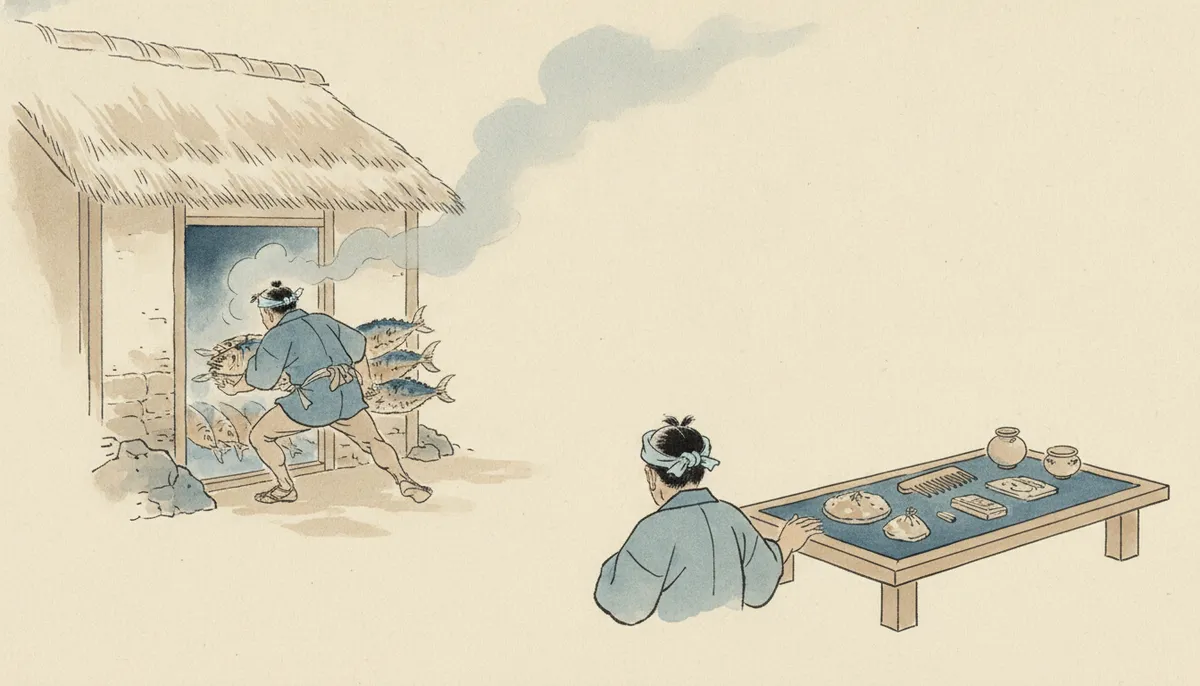
Inside the hut the heat of the kettles and the smoke were such that I sweated just standing there, and the smoke stung my eyes until I kept rubbing my face on my sleeve. Over the whole beach hung the smell of smoke. Behind the hut steam rose from a great cauldron, and young men lifted the boiled bonito onto a board and drew the bones out one by one. The cooled flesh was laid in the smoke of the hut next door, where an older man kept peering at the fire without a pause, to see that the wood never ran out. Bathed in smoke, the flesh turned pitch black. They would shave that black skin away thinly with a small knife, bring out the true color beneath, and dry it in the sun, I was told.
On the sand in front of the hut, bamboo racks stood in long rows, and the sticks lay on them in the sun, skin side up. Every so often a young man came by and turned them over, one by one. When cloud showed on the horizon, everyone in the hut stopped what they were doing and hauled the racks, sticks and all, in under the eaves. Every hut moved with the same hands.
Choosing among the three sticks was my job.
The middle of the shaving block had been worn by long years into a shallow hollow, like a dish. When I thought of laying the three sticks on it, I felt, before I had even begun to compare them, that the block itself was scolding me.
The first stick came out of a bamboo basket, and it was heavy. Its black, sooty skin felt rough and hard. When he knocked it against the corner of the block, it gave a dull gok.
A young man brought over two wooden boxes from the back. Along the wall some ten of the same boxes were stacked, and on the corner of every lid, cut with a small knife, ran a column of nicks. One nick, two nicks, three. The young man set the boxes with more nicks on higher shelves. Of the two now set on the block, one had two nicks and the other three. Beneath the three nicks the wood was still pale and bare.
The second stick, from the two-nick box, was a little lighter. Its skin had turned a deep brown, and here and there a pale blue-green powder clung to it. Knocked, it gave a kok, a note higher.
The stick from the three-nick box was covered all over in blue-green powder. The young man brushed it off with his hand, sa, sa, and the powder drifted up in a puff, smelling of dry earth and an old wooden box. Beneath it appeared a glossy skin of brown, close to amber.
I lifted it, and I looked up at the master without meaning to. It was light. Lighter even than the second. When he knocked it on the block, it rang out clear, kōn, and the sound came back from the rafters. No one in the hut looked up at it. They heard that sound every day.
Lighter than the first, and twice the price.
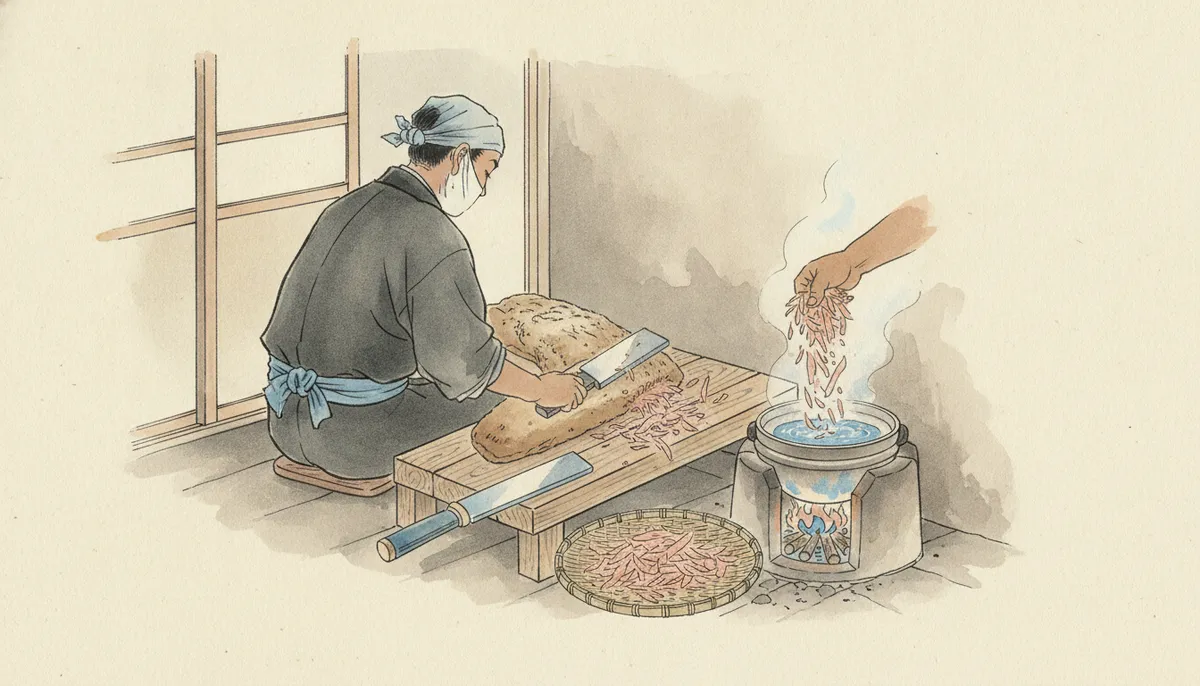
The master got to his feet without a word. He laid the three sticks on the block in turn and set his blade to them. Shak, shak. The shavings fell softly into the bottoms of three bowls. Over them he poured boiling water.
The first bowl clouded, with a few beads of fat floating faintly on top. The second stayed a thin yellow. The third was so clear I could see the shavings on the bottom, and it was the color of amber.
The master held out the three bowls to me one at a time, in the order for drinking. He did not hurry me, and he did not ask what I thought. He waited until I set a bowl down, and then offered the next.
I drank them in turn. The first had a taste with corners that stood up on the tongue. The second was round. The third, once I had taken it in, left a deep taste far back on the tongue that stayed and stayed.
"The third, it has to be made to bloom its powder a few more times yet. When it has, it's a taste ten days off."
A taste ten days off. I brought the bowl to my nose, and at the steam my mouth loosened into a smile in spite of me. It was the familiar smell, only much, much deeper. At the bottom the amber shivered quietly beyond the steam.
But I had to leave in five days. If I stayed ten days at the inn, the lodging would pile up. And I had a promise to keep with someone in the east. I counted the days on my fingers, and in the end I shook my head.
Then the first? Its price was the lowest of the three, and I could carry it off that moment. But the month's road ahead was one of loads biting into the shoulder. When I thought of hauling that heavy first stick every day, my palm already felt the weight. A light, dry stick would sit quietly at the bottom of a pack, and there was less work in shaving it. The second, at one and a half, was dearer than the first. Yet set against ten days' lodging, it would come out cheap.
"I can't wait ten days for the third. I'll take the second, then."
The master had the young man put the lid back on the second box.
"The second, I brush off the powder and dry it for a day. Come tomorrow noon."
The next noon the second stick lay on the rack in front of the hut, taking the sun. What caught my eye was the hand of the young man who was brushing off the powder. The powder had stuck to his palm, and blue-green stayed in the webs of his fingers and at the roots of his nails. It was the hand of someone who touched those boxes every day. He seemed not to mind it at all.
Yesterday's powder had come off clean, and the skin shone a deep brown. He wrapped it in bamboo sheath and I took it in my hand, and it was a little lighter than the day before. It smelled of the sun.
I paid the one and a half. The master took it, and was already setting the point of his small knife to the lid of another box. I saw over his shoulder that he was cutting a fresh nick. Which box it was for, I could not tell. As I left, I glanced at the boxes along the wall, and the three-nick box that the third stick had come from had been pushed up to the end of a high shelf. Beneath the three nicks the wood was still pale and bare. The day that box would open would come after I had left the beach.
I tucked the second stick in the bottom of my pack, and four days later I left Usa.
On the third day of the road, at an inn, I borrowed a corner of the hearth and shaved the second stick for the first time. The inn's fire was weak, and while I waited for the water to boil I turned the stick over in my hands again and again. Even when I laid the blade low and drew it as the master had, no petals came. Under my small knife the stick broke into chips and went flying. The thick chips would not loosen in the hot water and sank hard to the bottom of the bowl. Even so, the color of the broth was clearer than that of any soup at any inn I had stayed in. The traveler next to me, shoveling down his rice, peered into my bowl and sniffed.
"Where's that soup from, then?"
"I bought the stuff on a beach in Tosa."
The man tilted his head, said, "So that's a beach of sticks, is it," and looked down into his own bowl.
After that I shaved a handful a day. On days when no thin petals came, I crushed the chips in the hot water with my chopsticks, again and again. On the tenth day, taking it out of my pack to compare, I found it had grown thinner by a finger's width, for all I had shaved off. The light stick had been gentler than I expected, on my shoulder and in my pack. When I unpacked at night, from somewhere near the bottom there rose, faintly, that smell of dry earth.
I heated the water and took out a bowl.
I dropped a pinch of shavings into it and poured the hot water over. They loosen, they sink, and the water slowly takes on its color.
I wrap the bowl in both hands.
At the rim of the bowl, there is warmth.
Every tale is built on real scholarship. These are the Japanese-language works this one rests on — listed in full, so you can see exactly where the history ends and the story begins.
New tales are translated as they are written. Get each one — with a short note on the history behind it — by email.
 The Tales Only I Have Seen