— — That white block no monk's tray could do without: why were so many of them thrown away? — —
Ōmi, 1405 (Ōei 12) · 8 min read
New here? Why the narrator has been wandering for a thousand years is told in the Prologue.
There is a white, square block, small enough to sit on the palm. Lift it and it is a little heavier than it looks. Press it gently with a fingertip and it quivers, and the dent soon returns. Bring your nose close and there is a faint smell of beans.
Set your teeth to it and it crumbles softly away; lay it on your tongue and there is no strong flavour to speak of. Yet that very plainness is what lets it keep company with anything at all. Sink it in soup and it drinks up the soup; give it a scorch and it turns fragrant; chill it and nothing is left but the bean's faint sweetness. Nowadays it turns up as a matter of course in the hotpot, beside the sake, in the first bowl of the morning.
It is tofu. That familiar white block. These days, morning and evening, it sits on every tray as a matter of course. We hardly even think of its price. But few people know that behind this whiteness lay a heap of crumbled failures.
The block I hold now was surely made somewhere in a factory, by a great kettle and machines. I cannot see the maker's face or hands. But the logic that runs beneath this whiteness has changed little, then or now.
I stood witness to the reason for it exactly once. On a journey, I only glanced in as I passed — a brief moment, no more. No one taught me anything. No one called out to me. I only saw.
◇ ◇ ◇
In the winter of 1405 (Ōei 12), I came past the gate of a certain Zen temple in Ōmi with my load still on my shoulders. I was carrying charcoal to sell in the next village, on a road where I had to be over the pass while the sun was still high. It was a bone-cold day; each time I breathed out, my breath came apart in white and vanished. Frost lay thin here and there on the ground.
In those days the fields everywhere yielded little, and the number of people on the roads had thinned sharply. Even the backs of the loaded horses seemed somehow lighter. Whether charcoal would fetch a fair price in the village beyond the pass was doubtful.
The back gate stood open a narrow crack, its hinges creaking. White steam leaked out of it and unravelled softly into the cold air. Along with it came the peculiar smell of beans on the boil. It was a road I was in haste on, but drawn by that smell, I stopped.
Making sure no one was about, I put my face quietly to the gap. The roof visible past the gate had been patched with wooden boards where the tiles were chipped. It was neither a large temple nor a wealthy-looking one. Even so, the far end of the earthen floor was oddly lively with steam and smell.
From the depths of the earthen floor came the sound of a stone mill turning, heavy — gori, gori. Beans were being ground, I supposed. Between the beats of that unbroken sound, I sensed cloudy white water running off somewhere.
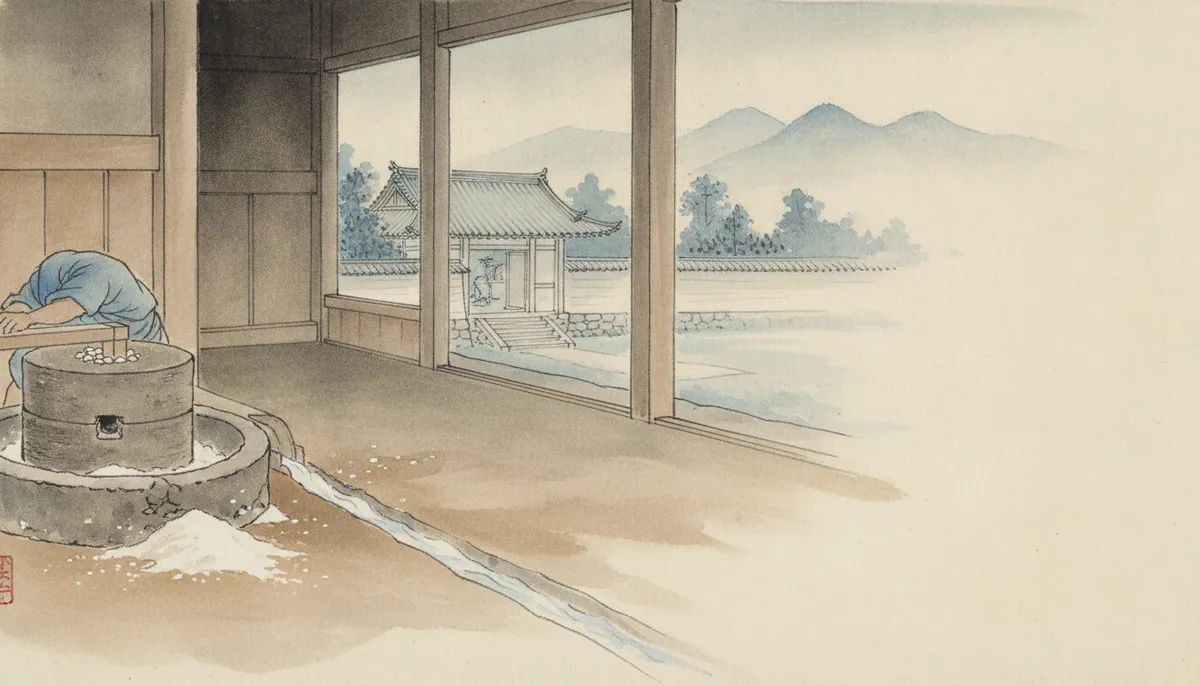
From the great pot on the stove, white steam rose without pause and streamed out through the gap in the gate. Through the steam I caught a glimpse of someone's arms wringing a cloth hard. From the wrung cloth the sound of water dripped on, drop after drop. In a gap in the steam I could faintly make out a second tub in the corner of the floor, where the beans had apparently been soaked. Grind, boil, strain, set — even by ear and nose alone, I could tell that much of the order.
Beyond the steam, the worn handle of a ladle peeped out. The sound of something being scooped and poured came again and again. But how long you must wait before the liquid becomes a block, how many stones you must lay on it before the water drains — that was the one thing that showed in neither sound nor smell. The eye that judges the moment seemed to lie only within the person moving those hands. From outside the gate, peering in, it was a knack I would never steal.
At a pillar, I saw through the gap four small pebbles set in a row. Was that how they counted the blocks that had set well today?
From somewhere deep within came the low sound of sutra chanting, in broken snatches. The steam of the floor, that voice, and the sound of beans being ground melded strangely together under the cold sky. I was a man with no tie to devotion, yet for some reason that layering of sounds was pleasant to my ear.
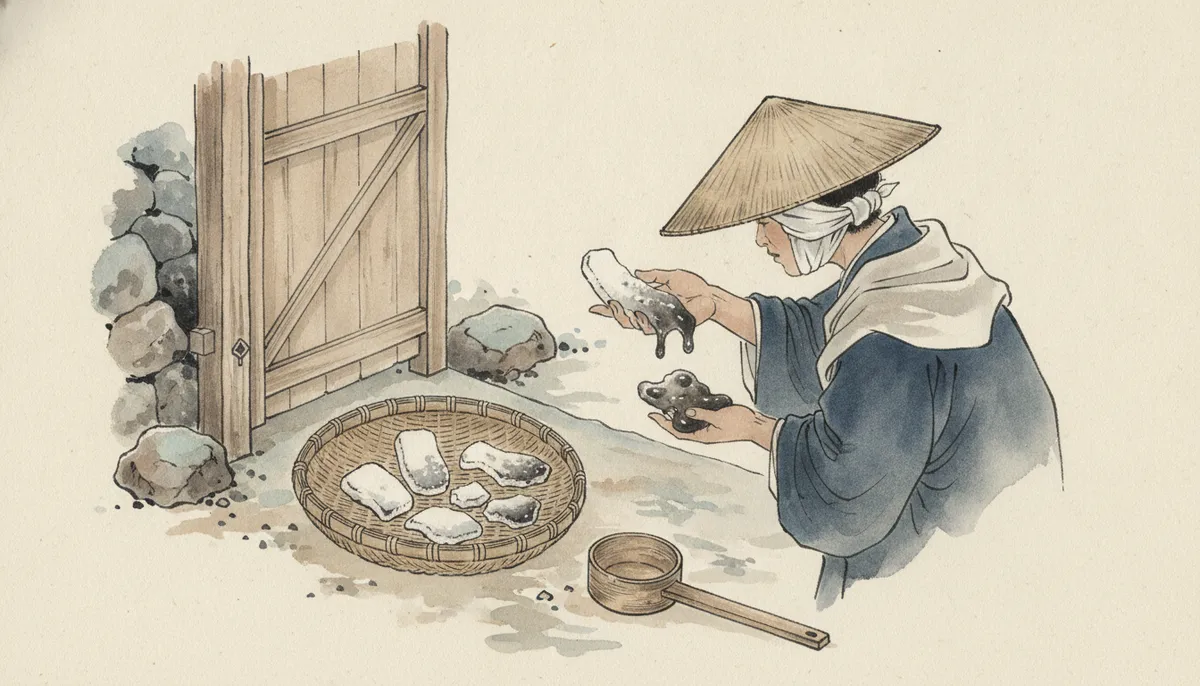
Just outside the gate, in a bamboo basket, several white fragments had been thrown away. I went closer and picked one up; it was so hard that a flick of my finger made it chip with a dry sound. I picked up another, and this one had crumbled and, waterlogged, spread limply across my palm. At the bottom of the basket five or six such fragments lay carelessly about. Perhaps they had cooled and set through the night — there was even a thin frost on them. There were more of these than the pebbles on the pillar. Made surely from the same beans, the same liquid, they had come out looking this different. If the amount taken up by that ladle strayed by even a little, this must be the result. I turned the two I had picked over in my hand, comparing them for a while. When I scratched the hard one with a fingernail, white crumbs fell like powder. The soft one fell to mush without my even pressing a nail into it. The weight left in my palm differed, too, if faintly. The hard one sank heavily into the hand; the soft one was surprisingly light. They looked the same size, but the water each held must have been altogether different. In a corner of the basket was also one pure white block with a chipped edge. It was so firm that a push of the finger left a dent that sprang back at once. It had set, but seemed to have been broken on being taken from its mould. So it was not only what was too soft that was thrown away. In the ditch right beside the gate, cloudy white water was being poured away without end. It came one stream after another before it could even soak into the ground. To pour away so much every day, they must be repeating the same steps again and again. Under the cold sky only that surface kept rippling white. The stones it ran down onto had gone dull and white at some point.
Beyond the stone mill, I saw the back of an old man, apparently a servant. His back was bent, and the arms showing from his patched sleeves were red and chapped, perhaps from the cold. Tossing yet another fragment into the bamboo basket, he murmured as if to himself.
"That's the third today…"
That was all. It was not said to anyone. The man turned his back at once and went back toward the stove. To judge by how few pebbles stood at the pillar, such days were not confined to this one.
Without quite meaning to, I checked the smell of the fragment I had picked up. No smell of scorching, none of rot. Only the smell of beans. Failure of this degree, perhaps, had not spoiled the taste much. Put in soup, might it not turn out surprisingly good to eat? Should I knock on the gate and ask whether he might spare me a piece? The thought crossed my mind. But a traveller with a load who suddenly showed his face would only invite needless suspicion. I put the thought away at once.
With the lean harvests of those years, kitchens were thin in every village, and I myself had no notion where I might find a night's lodging further on. My hand tightened on the load-strap without my knowing. In a year when even a single bean was no easy matter, to pile up so much effort and so many failures and go on making it all the same — I stood a while, taken by that stubborn patience. Far off, a temple bell tolled once, low. After the sound of the bell had died, only the sound of the wind stayed in my ear for a while.
Inside the gate, there was a sound like tubs knocking together, and the old man turned his face our way. I drew back from the gate, put the fragment quietly back in the basket, and hurried on down the road as if nothing had happened. I did not look back. The creak of the gate and the smell of the steam followed at my back for a time, but by the time I came to the pass they had grown faint, and I heard them no more.
Climbing the pass, I turned over in my mind the feel of that dry fragment that had soaked into my fingertip. The one I had put back in the basket was no longer in my hand. But the hard touch of it under my flicking finger would not fade. At a temple whose name I never knew, a servant whose name I never knew was surely standing before the stove today too. I hitched up my load and quickened my pace, to be on my way before the sun leaned. I never passed that gate again.
◇ ◇ ◇
That dry sound I heard when I flicked the fragment with my finger — I remember it still. As for how it is made, many books record it: grind the beans, boil them, strain them, and set them with bittern. But not one person has written down that dry sound.
The voice of that old man murmuring of the third failure, the four pebbles that must have stood along the pillar — none of it is set down anywhere. The bent back, the red and chapped arms, the steam leaking through the crack of the gate, the worn ladle handle — all of it must long since have rotted and vanished. And yet, whenever I test the softness of tofu with a fingertip, it comes back faintly, in the depths of my ear alone.
Every tale is built on real scholarship. These are the Japanese-language works this one rests on — listed in full, so you can see exactly where the history ends and the story begins.
New tales are translated as they are written. Get each one — with a short note on the history behind it — by email.
 The Tales Only I Have Seen