— — Why did that man give the weighting stone a single shake, and look for no other? — —
Shinano, 1480 (Bunmei 12) · 8 min read
New here? Why the narrator has been wandering for a thousand years is told in the Prologue.
Lift a spoonful on the back of a spoon and it is heavy. Sink it into hot water and press it with chopsticks, and it falls softly apart, and the sweet smell of beans and salt rises up.
Miso is a familiar thing to me. So when the lid of a great jar was first lifted in the mountains of Shinano, I knew what was inside by the smell alone. I knew, and still I could not look away. It was not the jar that held my eyes but the hands of the man standing before it.
The late autumn of 1480 (Bunmei 12), in the mountains of Shinano. The morning frost had turned the whole village white. The salt and needles on my back were mostly sold, and the pack was light, and my purse was the poorer for it. At the last inn I had heard that the Ōnin War had ended three years before, but that meant nothing to the frost up here.
In the yard of a farmhouse, an older man was setting stones into a ring and settling a great cauldron on them. The cauldron belonged to the house. The man was from the house next door, and his name was Hachirōta. When there were beans to be boiled, I learned later, this house called on Hachirōta every year.
I had set down my pack and was resting when he pointed his chin at the pile of firewood, without so much as looking at me.
"There's nobody to mind the fire. Food and a day's wage, till dark."
That was all he said, and he went back to the cauldron. I had no reason to refuse. I borrowed a hatchet and set to the logs half split. The water was run up from the spring in the valley, again and again, by a boy of the house. His cheeks were red with cold, and his hands were always wet with spray.
In the yard the household was on edge from morning, every one of them. It came but once a year. The master of the house kept glancing even at the way the cauldron was set. Hachirōta turned his face to none of it.
The soybeans, soaked since the night before, swollen and soft, were tipped from their basket into the cauldron. I tended the fire. Better to cook them fast, I thought, and I fed in wood by the armful. Before long a nasty crackling came from the bottom of the cauldron, and the smell of scorching stung my nose.
Hachirōta said nothing. He pulled two logs from between my fingers and drew the fire back, scraped the bottom with a long ladle, and lifted out only the scorched beans into a separate bowl. Then he took one floating bean, held it between thumb and little finger, and crushed it with a firm squeeze. The bean gave without a sound and turned to a sticky meal.
I pinched one the same way. There was still a core in it, pushing back against my fingers. I let the fire down very low and split the wood over again. I watched how the steam rose from the cauldron until my sweat had gone cold. Make the logs the same thickness; keep the flame licking the bottom of the cauldron at the same height. It was only that, and it was harder than I had thought. That fire grows stronger when you feed it, I had known in my head. Knowing it, and having the hand remember it in front of a cauldron, were different things. The bean I pinched, some time after, crumbled softly between my fingers. Only then did Hachirōta pull out all the wood beneath the cauldron.
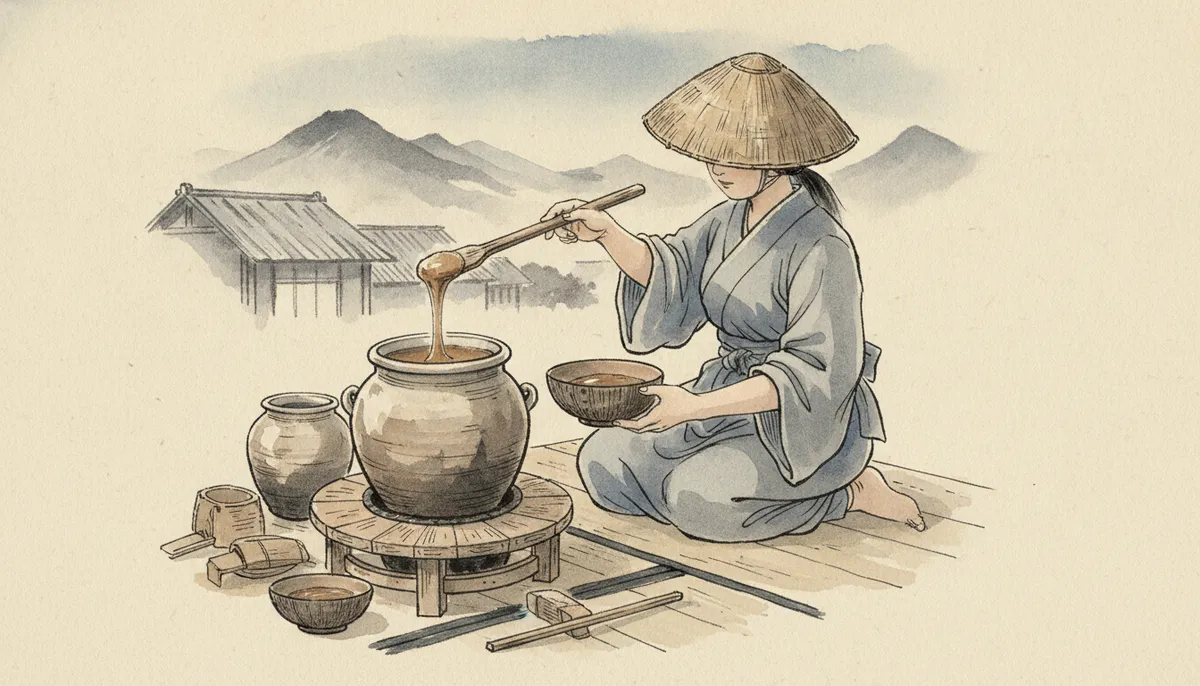
The boiled beans were drained and tipped into a mortar set in the yard. They must be pounded before they cool. I took hold of a pestle. Across from me Hachirōta brought down the other pestle in time with mine. As we struck in turn, the beans lost the shape of their grains with every blow and became one heavy mass. When my arms had begun to ache, Hachirōta tapped the rim of the mortar lightly. That is enough, it seemed to mean.
Salt and kōji, the grain grown over with mold that starts the fermenting, were mixed into the pounded beans. There was no scale to weigh them. Hachirōta scooped up the salt in his hand and let it fall, one scoop, two scoops, counting under his breath. The amount that lay in the hollow of that palm would be the same, I thought, whatever the year. His fingers went on moving through the roughness of the salt without a pause. With too much salt it will not spoil however long it sleeps; with too little it goes bad in the dark. That line between the two, Hachirōta seemed to measure with the pad of his finger alone.
The mixture was rolled into balls the size of a fist. The inside of the jar had been passed through hot water the day before and dried in the sun. If even a little damp is left, they say, it goes bad in the dark. The balls went into the jar one at a time, flung in hard, and each time Hachirōta pressed down to the bottom with his fist, to leave no gap. By the time the jar was full, the day had tilted well over. My arms were like sticks. When it was full, he spread a good handful of salt thick over the top and laid on a wooden lid.
The stone to weight the lid was left to me to choose. I carried three or four from a corner of the yard and brought over the flat one that looked likeliest to sit well. Hachirōta set it on the lid and shook it once with his hand. It did not so much as click. He made no move to look for another stone.
In the evening, in a corner of the earthen floor of the house, Hachirōta was looking over two jars. Beside the one laid down today stood the jars that had been in the house before. One was small, with a rope around its neck and a single knot. The other was old and blackened, with two knots. Each time summer came, I was told, the master of the house tied one more. The rope on today's jar had no knots.
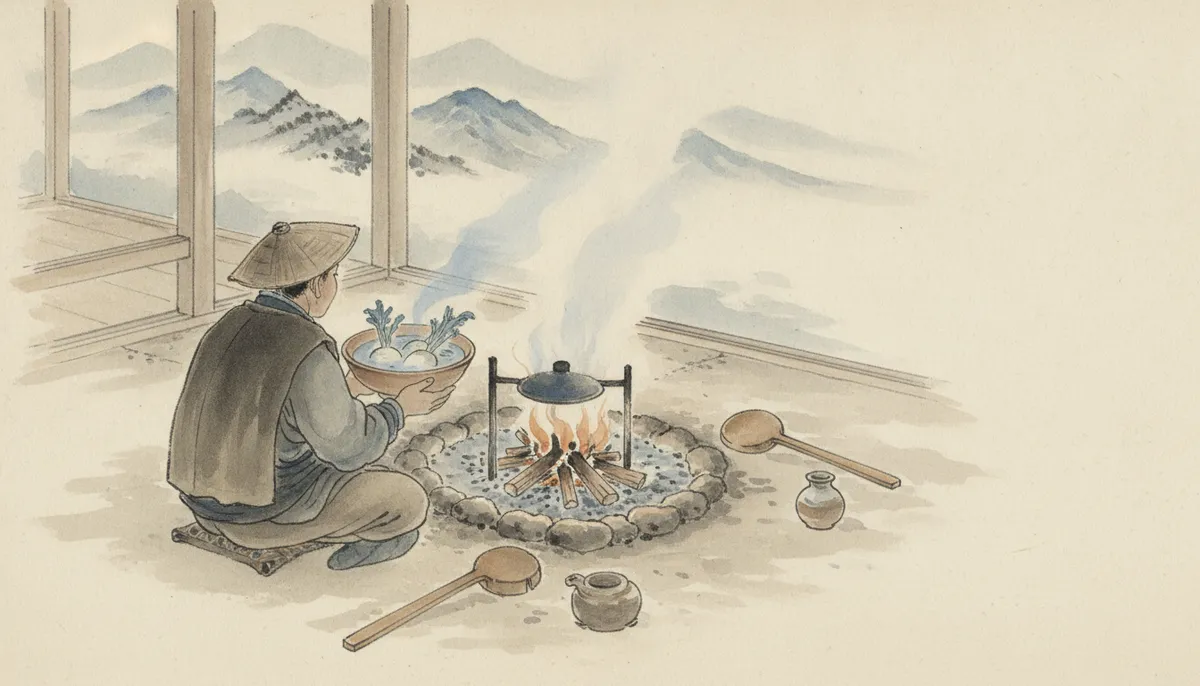
Hachirōta lifted the lid of the jar with two knots. On the underside, a white flower of salt had faintly bloomed. The miso inside was a dark red, and glossy. Where a white film had spread over the top, he took the tip of the ladle and skimmed away that spot, and only that spot, with care. Into the place he had cleared he scattered one more pinch of salt, set the lid back, and shook the weighting stone once with his hand. It was the same motion as with today's stone. It must be a jar he looked in on almost every day. The wood along the rim of the lid shone black with the grease of hands. The smaller jar was far paler in color. Beside me, as I compared the two, Hachirōta's lips moved faintly. He traced the knot on the little jar's rope with a finger, and then looked back toward the yard. The cauldron, the mortar, the jar just laid down: all of it was already sinking into the dusk.
The soup that night was made with miso from the jar that had passed two summers. For the filling there were only two scraps of daikon floating in it. The household must always eat like this. No one wore the face of one ashamed that there was so little in it. And still, when I took the bowl in both hands and put my mouth to it, the corners of the salt had gone round, and the sweetness of the beans came quietly after. So this valley, too, can bring out such a taste. Thinking it, I could not set the bowl down for a long while. To wait through the summers twice, in the dark, with hands that own no scale. It was those hands I admired.
When I asked for more soup, the master of the house glanced at the miso jar, and nodded with his eyes alone. Beside him Hachirōta, without a word, was ladling out a second bowl.
I slept on the straw in the barn. Before sleeping, I counted over again the coins I had been given as the day's wage. However many times I counted, the number was the same, and I could not stop my hand from counting. Outside it was so cold that I could almost hear the frost settling. The straw was damp and rustled coldly under me. Tomorrow's lodging, and the day after's, were not settled. A drifter's life is like that, and I knew it, but on a cold night the dark was longer than usual.
The next morning the master of the house laid a pinch of miso, wrapped in a magnolia leaf, in my hand. Hachirōta had already been called away to help next door, they said, and had gone up the frosted road. He did not look back. I put the leaf packet inside my robe and set off down the other way. The frost had not yet thawed and broke up fine beneath my feet at every step. Through the leaf, the faint warmth of the miso seeped slowly into the cloth at my chest. Over the two mountain passes I put my hand to that packet again and again.
Now I can explain what was happening in the dark of that jar. The kōji cuts the protein of the beans fine and loosens it, and all the while the salt keeps the bad things away. And yet being able to explain it does nothing to lighten the scoop of salt that Hachirōta measured out by hand.
In the autumn of the following year I passed through the same valley. There was no cauldron in the yard, and someone working in the fields told me Hachirōta was in the yard next door. The one lifting the lid of the jar on the earthen floor was the boy who, the year before, had gone running about with water. In his small palm lay one white grain of salt.
Every tale is built on real scholarship. These are the Japanese-language works this one rests on — listed in full, so you can see exactly where the history ends and the story begins.
New tales are translated as they are written. Get each one — with a short note on the history behind it — by email.
 The Tales Only I Have Seen