— For half a year the man did nothing but count the days on his fingers —
Lake Biwa, 1010 (Kankō 7) · 7 min read
New here? Why the narrator has been wandering for a thousand years is told in the Prologue.
Ten melons, and one shō of beans, a little under two litres. That was all I paid in exchange for one tub of narezushi, the old sushi, in which fish is pickled in rice and left to ferment.
Half a year's wait, for ten melons. Whether that was cheap or dear, I still cannot tell. I can say only this: until the day the lid was cut open, I was never once allowed to see what was inside the tub.
"Go to Akimaru. There's no tub more reliable than his."
I walked through three villages along the shore, and it was always the one name: Akimaru.
Akimaru dealt in crucian carp, dace and carp. Behind his house stood some twenty tubs, large and small, every one lidded and pressed down under a rope. On each lid sat a single round river stone. The stones were of different weights from tub to tub, and on some tubs something like water had risen up in the gap between lid and stone. When I went near to look, Akimaru snapped, "Not yet," and drove me off. A sun-browned arm; thick fingers that moved only when he counted his tubs. Perhaps his few words were part of his reputation too.
"One tub, ten melons. And a measure of beans thrown in."
When I heard the price I fell silent and thought it over. Set against getting through a whole winter shut in by snow, I could not say it was dear or cheap.
That day, in the yard out back, Akimaru's wife was spreading freshly steamed rice on a straw mat to cool. I asked what it was for. "For the tubs," was all she said, and turned her face away into the steam.
"When will I have it?"
"You wait half a year. Around the time the snow comes. Until then no lid is lifted, for anyone."
That was all Akimaru said, and he went back to checking the rope on a tub. How long the fish had been in, or when it would be ready, he hardly answered when asked. His whole manner of replying was to fold down his fingers as though counting days and murmur, "Another so many months." Along the side of each tub, following the weave of the rope, small notches had been cut, a tally of the days since it was packed. Only Akimaru could read them.
I handed over ten melons and a measure of beans and left. Akimaru's wife took the melons and beans and carried them into the house. Akimaru tied one more knot in the rope of a tub. That, he said, would be the mark of mine.
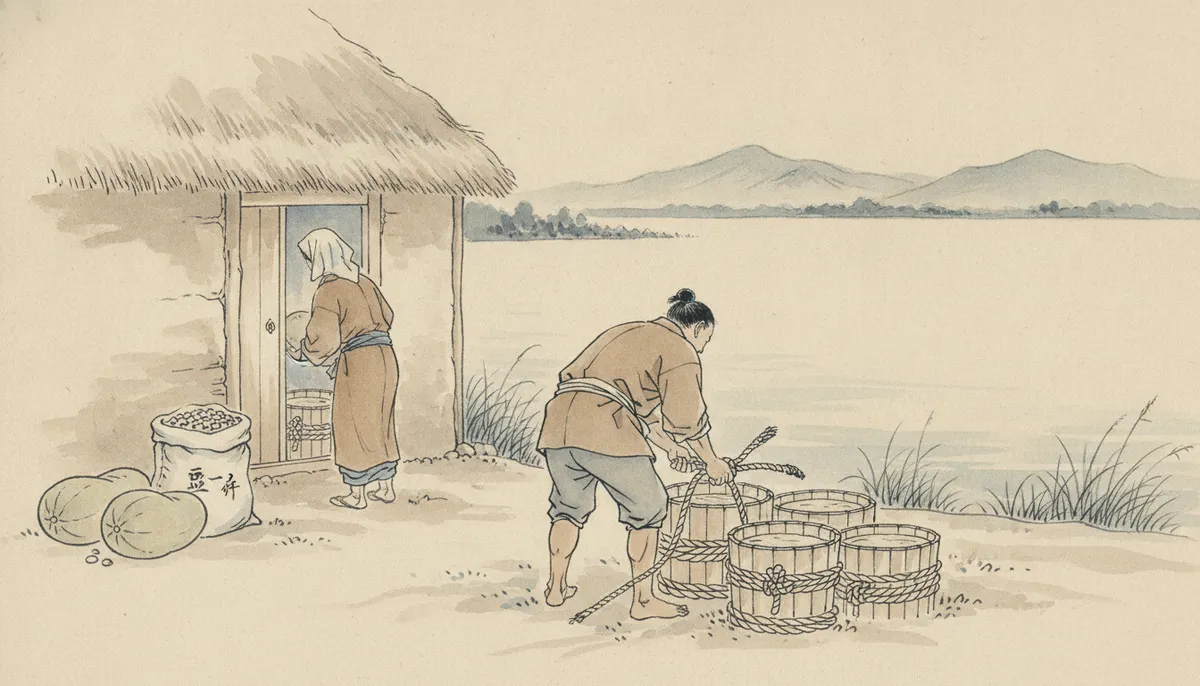
For some months after that I was hired to help with the rice harvest and earned my keep, and the ten melons were pushed to the back of my mind. Each time I passed behind Akimaru's house I stole a look along the row of tubs. Their number never grew or shrank; they simply sat there, settled. The sour smell grew stronger by the day and caught in my nose. Every morning Akimaru counted the tubs from one end to the other, checked the ropes, and pressed each stone with the flat of his hand to feel whether it sat firm. That was about all an outsider could learn of what was happening inside.
At the house where I was hired for the harvest, porridge was served at midday. Holding the steaming bowl, I found myself wondering what the fish and the rice were doing to each other in that tub just then. The porridge soon cooled, but what was in the tub, far from cooling, must still have been at work.
An old man of the village told me that the carp-sushi of this lake was even sent up to the court in the capital as tribute. After that even the stones on the tubs began to look like something to be thankful for.
Once I noticed that a single tub had been set apart in a corner of the yard. Its rope had slackened, and a reddish-black liquid was seeping out from under the edge of the lid. I asked Akimaru's wife as she passed, and she said only, "That one has gone bad," and grimaced. Of twenty, she said, one or two at most end up set apart like that. A tub that cannot be sold is kept away from the rest. Whenever she walked past it, she quickened her step.
The other tubs seemed sound. My own tub, too, was sleeping somewhere in that row.
The bustle of the harvest swept through the village and was gone, and before long the leaves had fallen from the trees. The wind off the lake grew colder day by day.
When snow was in the air I called at Akimaru's house, and at last he told me, "It's ready." I went round to the back. The lid of one of the tubs had been unbound and lifted off. Two other men were there already, waiting for their share, standing in front of their tubs. They all had the look of men who had waited half a year with nothing to go on but a price and a notch on a tub.
Akimaru's hands worked at the rope, and I and the two others watched them with held breath. It was exactly half a year from the day I had paid the ten melons.
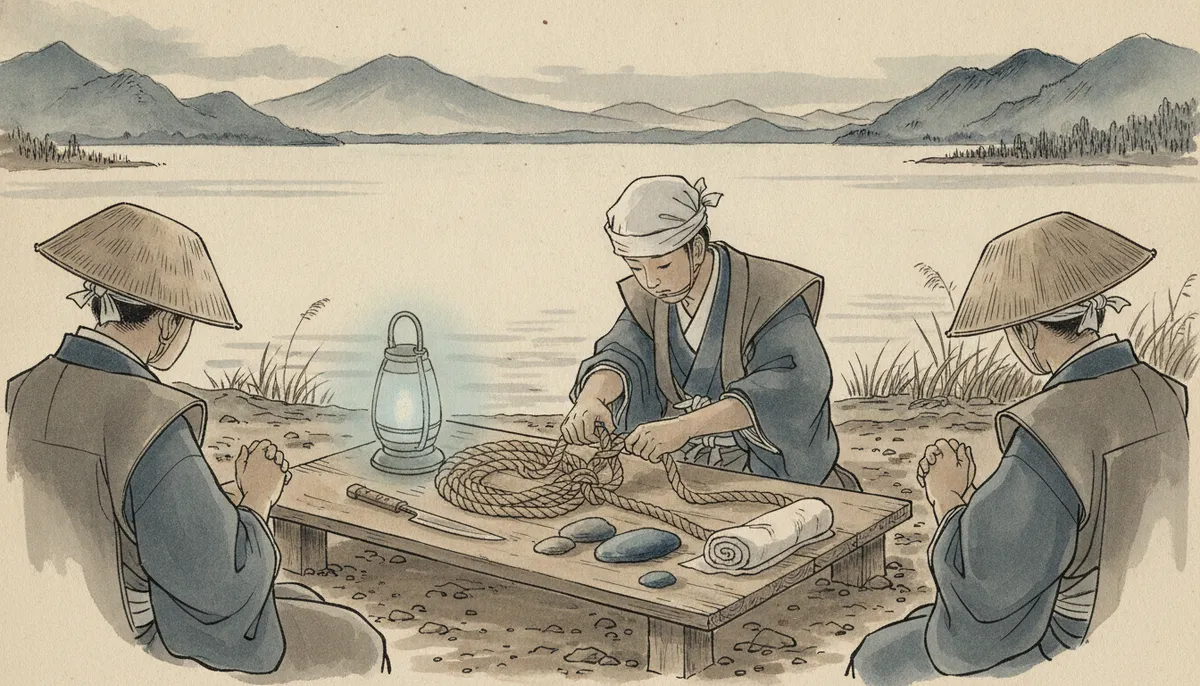
The moment the lid came up, a smell rose that struck straight through the nose, and my eyes watered. To anyone unused to it, it was a smell to choke on. Out of the tub Akimaru lifted a single crucian carp, stained the colour of amber, gently, in both hands.
"The worth of ten melons and a measure of beans is this."
He held out one slice, and I put it in my mouth. Sour. Salt. The bones had softened and melted, and it tasted like some living thing entirely apart from raw fish. I had never once seen the shape of the fish as it went down into that tub half a year before. Because I had not seen it, I could not, for all my trying, join what lay in my hand to what had gone in. The roe the fish had carried in its belly had set thick and orange, each grain like a separate food.
At the bottom of the tub remained something white, gone to a sludge. Akimaru did not touch it. He scooped out only the fish from my tub and moved them into the vessel I had brought. I counted eleven. A fish and a bit for every melon, by the reckoning. One of the two other customers reached a finger toward the rice. Without a word Akimaru lowered the man's wrist from the rim of the tub, and then moved only the fish into each of their vessels. Not one of them ate the rice. The rice that had held the fish for half a year had, it seemed, done its work.
A small daughter of Akimaru's was clinging about his feet. "It stinks," she said, pinching her nose, yet she begged a slice from her father's hand and chewed it with a scowl. When she reached for one more, Akimaru said, "That's all for today," and laughed, with the look of a man grudging what he must share out to his customers. He stroked her head once, and turned back to the tub.
The two other customers took their fish home, one carrying the whole tub, one wrapping his share in cloth, each in his own way. Akimaru told me afterwards that the price and the day of handing over differed a little from tub to tub. The earlier a customer had ordered, he said, the better the place in the row his tub was given.
"Will you order again next year?" Akimaru asked, and I shook my head. When I told him I would leave once the snow melted, he said only, "I see," and asked nothing more.
He gave me a handful of salt to see me off. There would be no more stealing glances along the row of tubs. The weight of the fish I had been given was all that remained to prove the half year I had spent in that village.
Whenever I pass the front of a shop selling funazushi, the crucian-carp sushi of Ōmi, I am taken back before that tub even now. It is still made the same way, with the same trouble, not much changed. And deep in the sour rice of pressed sushi, a distant ancestor of that smell lies hidden.
Even so, only that one instant, when the lid came off, still stays at the nape of my neck. Written in no ledger, on no one's lips: just an instant, and the shiver of it as the smell struck my nose.
Every tale is built on real scholarship. These are the Japanese-language works this one rests on — listed in full, so you can see exactly where the history ends and the story begins.
New tales are translated as they are written. Get each one — with a short note on the history behind it — by email.
 The Tales Only I Have Seen