— — How did strangers talk to one another in the steam? — —
Edo, 1813 (Bunka 10) · 8 min read
New here? Why the narrator has been wandering for a thousand years is told in the Prologue.
"Master of the komamono shop — which way is the bathhouse?"
I had my hand on the shop door when the voice called out behind me. I turned. A young man with a bundle wrapped in a cloth on his back stood there, out of breath, his shoulders heaving. From the lilt of his speech I could tell he had come from the Kamigata country, the Osaka side, not long ago.
I took my hand from the door and let a breath pass.
"The bathhouse? Out the gate, second corner."
"Yes — the bathhouse. I'm Banzō. I came up to Edo last month."
It was autumn of 1813 (Bunka 10), and the sun was already dropping toward the roofs of the back-alley tenement. In the gutter boards, the water from the day's washing glinted a faint red.
He had no hand-towel with him, and his purse hung half out of his sash. It troubled me to send such a man off alone. I pulled two towels from the shelf, slid the door shut and turned the lock, and set off beside Banzō toward the gate.
As we ducked under the curtain, the woman on the bandai, the attendant's raised seat, looked up.
"Sakuzō, you've got company today?"
She looked Banzō over, from his feet to his head, once through, and added only, "The water's hot today."
I set the bath fees for both of us on the platform. When Banzō went fumbling for his purse, I stopped his hand with my palm. He looked up, abashed, at the woman on her high seat. From the bandai the whole undressing-room can be taken in at a glance, and the one who sat there was the oldest hand in the house.
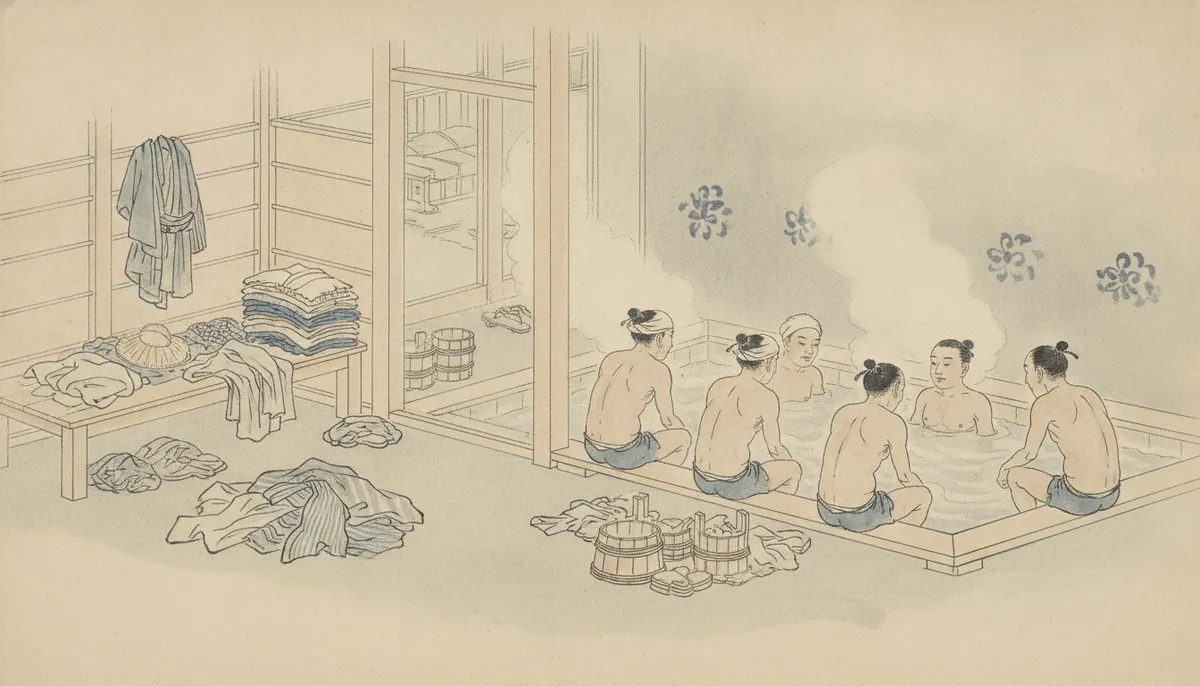
In the undressing-room, rows of identical baskets lined the shelves. Banzō folded his kimono and began to wrap it up, just as it was, in his bundle-cloth. I took a basket and set it before him. A retired man's coat, a peddler's short happi coat — they lay curled up the same way in baskets that were not their own. Banzō's clothes went into a basket next to the peddler's coat. Before long no one could have said which belonged to whom.
The washing-floor of bare boards was white with steam. Banzō started straight for the tub. I caught his arm, pulled him back, and handed him a wooden pail.
"This first."
Scoop up water in the pail, over the shoulders. I showed him: three times. Banzō copied me. Each time the water ran over him, I could see his shoulders drop a little. The boards under our feet were wet and slippery.
Several men were already crouching on the washing-floor. Some wrung out their towels; some were scrubbing each other's backs. One of them nodded to me, and then he nodded to Banzō too — to a face he had never seen. In a bathhouse, everyone did that.
At the far end of the washing-floor stood a partition of boards, like a wall. The boards came down from near the ceiling almost to the floor, and below them was an opening, just wide enough for one person to pass, stooping. Beyond it, all was white with steam, and already dark.
"That's the zakuroguchi — the pomegranate mouth. Drop your hips, and lower your head."
I went first, bending my knees to pass through.
Inside, the steam was so thick that I could scarcely make out my own hand before my nose. Only the sound of the water and the voices of men came strangely close. Here and there in the tub, heads floated dimly.
There was a dull thunk, and behind me Banzō cried out, "Ow!" He seemed to have struck his forehead on the rim of the opening.
"A new face, is it?"
A voice, half laughing, came out of the dark.
"Y-yes. Sorry about that."
"Which tenement, then?"
Another voice asked it, from somewhere beyond the steam. There was no face to go with it. And because there was none, the voice could be as easy as it liked.
"Behind the soba shop. I only just moved in…"
"Ah, that room at the end. The one with the thin walls. At night, hold your cough in."
Laughter spread across the tub, and Banzō's shoulders eased a little.
Right beside me, a peddler who sold from baskets slung on a shoulder-pole, a botefuri, sat sunk to his neck with his eyes shut. Next to him there was the white head of a retired man, an inkyo. Two men of different trades and different stations, shoulder to shoulder, sharing the same water.
Banzō touched the tips of his toes to the water at the edge of the tub, and drew them back. I sank in to the shoulders ahead of him and began to count. One, two, three. Banzō put his foot back at about seven, and by the time he reached ten he was in up to the shoulders. I told him that while it was hot he should not hunch up, but breathe out slowly; he did as he was told, and said, "It's true," with a small laugh.
"Why is the opening so dark and low?"
"To keep the steam in, I've heard. If it went cold, a bathhouse would be no business at all."
Banzō looked up at the darkness over his head, and let out a breath — hmm. The heat of the water crept slowly up as far as his waist.
"Here — the women, do they…?"
He lowered his voice.
"I hear some bathhouses keep them to separate hours. Others still have men and women in the one tub. The authorities have issued their orders more than once, but, well, it doesn't take."
"Oh," said Banzō, and in the water he gently pressed his reddened forehead.
When we came out through the pomegranate mouth we ducked again. This time Banzō did not hesitate for even a breath. Out on the washing-floor he took another pail of water over himself and rinsed off. We both hung our wet towels over our shoulders. I scooped up a pail and poured it down Banzō's back too, from the shoulders, so he would not catch a chill.
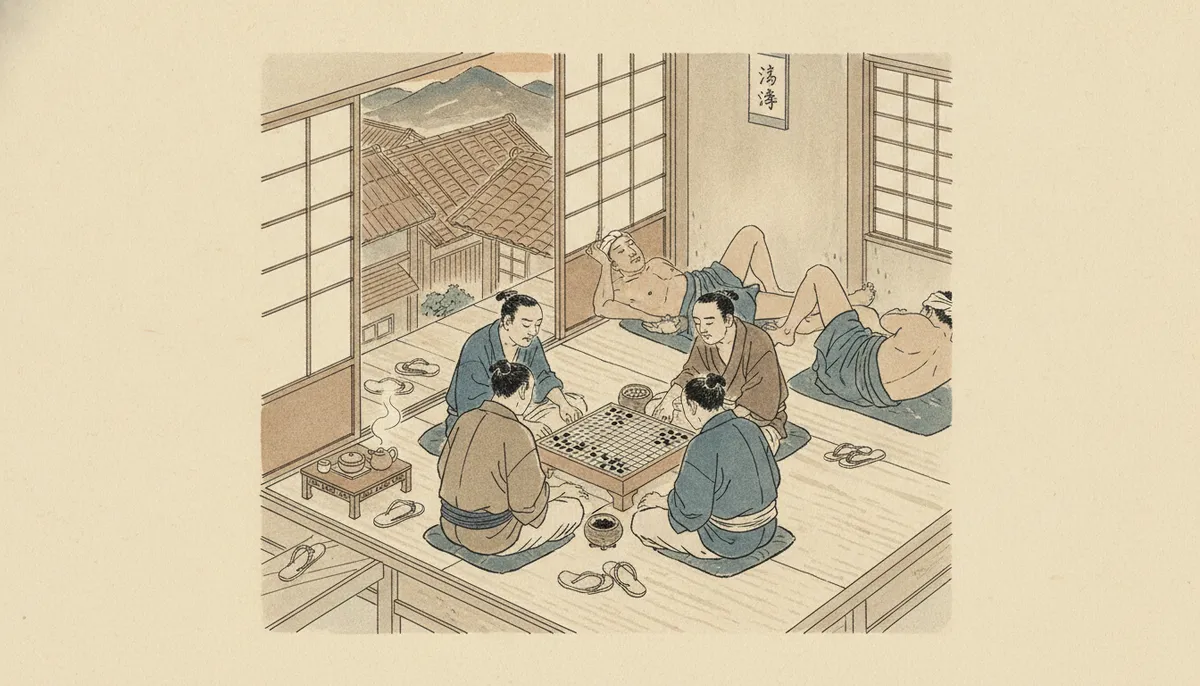
When we came up from the bath, there was a steep stair beside the bandai that led to the second floor. For feet fresh from the bath it was a little frightening.
The upper floor cost extra. Banzō opened his purse again. But I had already paid at the bandai, for the upstairs, for both of us. Banzō started to say something, and stopped.
At the top of the stairs lay a wide room. The windows had been thrown open, and the evening breeze came in cool against skin warm from the bath. Trays of tea and sweets stood here and there about the room. Below the window we could see the bathhouse's roof tiles and the washing hung out at the tenement across the way. Two sparrows flew low over the drying-pole. In one corner a retired man and a peddler sat on either side of a go board, groaning.
Banzō sat down by the pillar in the farthest corner, his knees drawn together. Though he was warm and flushed from the bath, only his back was perfectly straight. I took two cups from a tray and set one in front of him. The tea was hot, and bitter on a throat fresh from the bath. A finished cup you carry back to the tray yourself. It was not that anyone had decided so, but I always did. Banzō watched my hands out of the corner of his eye, and when he returned his own cup he set it down at the edge of the tray, so softly that it made no sound. That he knit his brows for a moment at the tea's bitterness — that, too, I thought afterward, was rather endearing.
"Brother — you're from the Kamigata?"
The retired man said it without lifting his eyes from the board.
"Y-yes. From Osaka."
"Oh? Can you carry loads? The rice dealer who comes to my door is looking for one more man."
Banzō held his cup in both hands and forgot to nod. The old man, seeing it, seemed pleased more by the lateness of that nod than by anything else.
The peddler set down a stone, and it clicked.
"Hey. Do you play go, brother?"
"I don't."
"Then don't. Just sit. Put a stone down there."
A great laugh went up. Over by the board a tray of sweets went round, and a dumpling landed in Banzō's palm. He was being laughed at, and he laughed back. The stone he had placed the retired man looked at for a long while, and said only "Not bad," and left it where it was. Outside the window, the sky above the roofs was darkening, as if a single stroke of indigo had been added to it. The red on his forehead had already blended into the glow of the steam.
On his way out, at the foot of the stairs, Banzō held out his towel.
"I'll give it back."
"It belongs to the shop. Take it."
Banzō slung the towel over his shoulder, bowed his head again and again, and left toward the gate. I stood inside the curtain and watched until his back turned the corner.
I heard afterward that the next morning he went by in front of the gate, shouldering the rice dealer's load. The towel was on his shoulder.
Today's public baths have no pomegranate mouth. Above the tub there is a high ceiling, and the steam escapes up into it.
And yet, when I step over the edge of the tub, even now my knees fold of themselves. My hips drop, my neck draws in. Though there is no chance at all of my striking my head on the ceiling.
The baskets in the changing-room are the same, too, still lined up. Every one of them wears the same face, waiting for someone's clothes.
One evening, in front of a bathhouse curtain, a child just out of the bath is waiting for his mother. In one hand, a towel heavy with water.
Every tale is built on real scholarship. These are the Japanese-language works this one rests on — listed in full, so you can see exactly where the history ends and the story begins.
New tales are translated as they are written. Get each one — with a short note on the history behind it — by email.
 The Tales Only I Have Seen