— — What a small apprentice remembered, in a single square of cloth — —
Osaka, 1802 (Kyōwa 2) · 8 min read
New here? Why the narrator has been wandering for a thousand years is told in the Prologue.
Before he wrapped anything, Mankichi always flicked the corners of the cloth twice. He was that kind of boy.
It was not quite shaking off dust, and not quite a habit either. I watched that gesture of his in a shop front in Osaka. Whatever he tied, the bundle came out in just the shape the carrier's hand wanted. The cloth was called a furoshiki. Some say the name comes from wrapping clothes in a bathhouse, or so I have heard, but I do not know for certain.
It was the spring of 1802 (Kyōwa 2), in Osaka.
I had made my base in Osaka and went about the provinces with cotton on my back, a small trader. That day I had gone up to the Izutsuya, a cotton merchant in Tenma, to ask for an introduction to a supplier. But the moment I passed under the shop curtain, the mistress, Okuni, came tumbling out of the back office and caught me by the sleeve.
"Oh, you've come at the right time. The head clerk and the clerks are all off at the wholesalers' meeting, and the goods have come down in the storehouse out back. Lend me a hand, would you?"
There was no time to refuse. My pack was set down at the shop front, and I was dragged off to the storehouse. What had fallen was a whole shelf of tanmono, bolts of cloth, and one stack of them had spilled across the earthen floor. In the shop front stood the apprentice, Mankichi, a boy of about ten, still holding his broom. Okuni had said, "You, sweep out front," and left him alone to mind the shop.
I picked the bolts up one at a time, brushed off the dust, and put them back on the shelf. The smell of indigo and the weight of damp cloth bore down on my arms. From the front, through the curtain that screened the partition, I could hear Mankichi's voice as he dealt with a customer. A customer had bought a hand towel, and he said only "Here." He laid the cloth down on the slant and folded in a corner. At each fold, a small breath counted — one, two. All the while I was picking up the fallen bolts, that voice did not break off, and his tying hands never hesitated.
To me it sounded like more than a child helping out. But the work in the storehouse was piled up before my eyes, and I had no time to turn my ear that way. The bolt at the very bottom of the fallen stack had taken on the indigo of the others, and its edge was faintly blue. Okuni clicked her tongue at the sight. "Nobody can say the dye was poor," she said, to no one in particular.
I had put back perhaps thirty bolts when the door sounded out front, and Okuni looked up.
"Another customer. I can't take my hands off these bolts just now. You, go out."
"I am only a peddler—"
"We'll talk about the introduction later. Go on, quick."
She pushed me in the back, and I went out past the curtain.
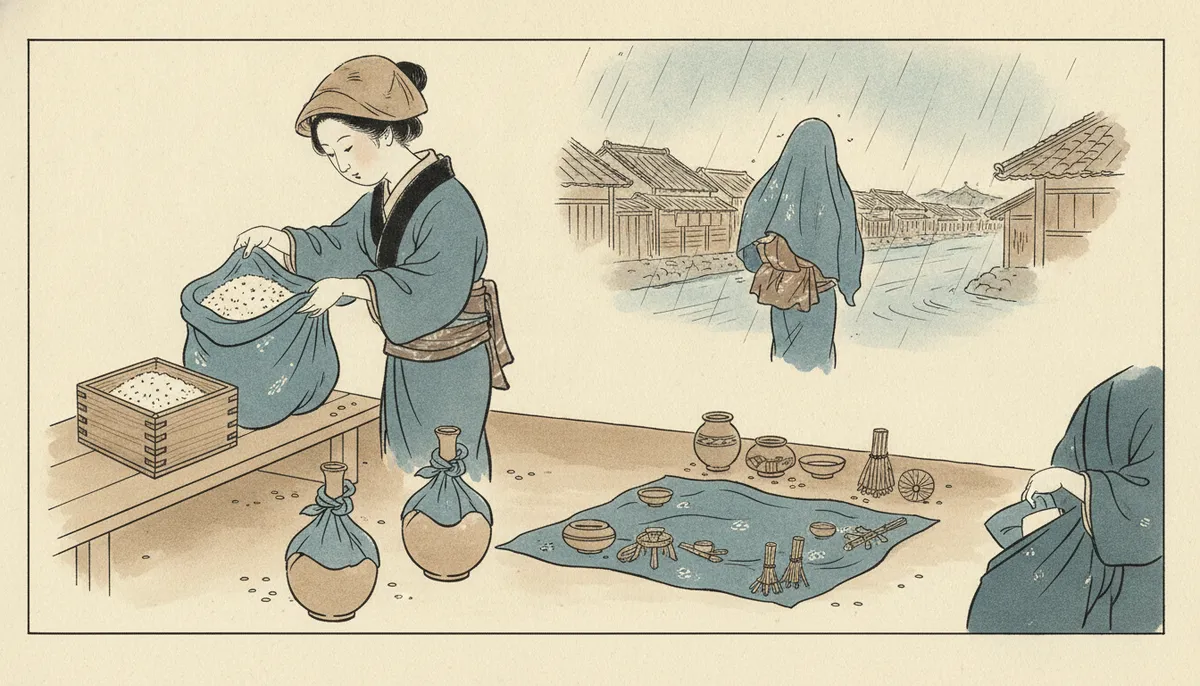
In the shop front stood a wife, soaked through. She must have run through the spring rain: in one hand an umbrella, in the other she hugged a sake flask. Her name was Otama.
"I've been invited to a wedding in the next town over," she said. "I want to carry the celebration sake without getting it wet. Would you wrap it in a furoshiki for me?"
I never got around to saying that I was not one of the shop's people. I pulled out a spare cloth I had been carrying on my load and set the flask in the middle. Wrapping a load was something I did every day. I drew the four corners together at the top, knotted them hard, and handed it to Otama.
"Well then, I'll be off—"
At her second step, the flask tipped over inside the cloth. Sake seeped out near the stopper, and the corner of the cloth darkened fast.
"Oh no, and it's the celebration sake!"
Otama's voice cracked. I apologized again and again, but my hands hung in the air, stopped. Rice or bolts of cloth do not mind if they tip. That sake has to be carried upright had gone clean out of my head.
Then a small hand reached in from the side.
It was Mankichi. He stood his broom against the wall, took the bundle from Otama's hands, and without a word undid the knot. He picked up a corner of the cloth and snapped it twice, folded the sake-soaked corner inward, and stood the flask up straight in the middle of the cloth. He brought the near corner round into the hollow of its neck.
"One."
He laid the opposite corner over it and drew it taut.
"Two."
He twisted the two ends, and twisted them, and twisted them once more.
"Three."
He tied the leftover ends in a square knot, and the knot itself became the handle. With the cloth that remained, he draped the flask's shoulders softly. The flask stood upright and did not tip in the least.
"Try holding it. Take your umbrella in the other hand. Neither hand's tied up."
Otama picked it up by the handle and walked two or three steps across the earthen floor, fearfully. The flask swayed, but it did not tip.
"Mankichi. Where did you learn that?"
I could not help asking. Mankichi answered gruffly, gripping his broom again.
"The sake shop errand game. You fill a flask with water, carry it, and run to Tenjin Bridge. If you spill, you lose."
Having said it, Mankichi went back to moving his broom. I was recalling the three moves of a moment ago. Round the neck. Twist. Cover the shoulders. It was an order of steps so that the flask would stay standing, whether you ran, or the rain beat on it.
From the storehouse in the back, Okuni's voice flew out.
"Mankichi, what are you doing? You see to the customer."
"Already did," said Mankichi, flatly.
Okuni went quiet at that, and after a while, from beyond the curtain, I heard a sound different from the head clerk's abacus. The sound of a paper packet being opened. When the mistress came out, she pressed a small paper packet into Mankichi's hand. "That's for tomorrow's errand. Give it to the sake shop at Tenjin Bridge first."
Otama thanked us over and over, opened her umbrella, and went out into the rain. The handle of the flask swung, gently, gently, to the rhythm of her steps.
As for me, I stood there with my two hands now empty, not knowing what to do with them. Until a moment ago, I had thought myself as practiced as anyone at wrapping a load. Drawing the four corners together and knotting them is a way of wrapping that holds whether the load stands or lies down, but for sake, which has to stay upright, it did not hold. Mankichi glanced at my pack where I had set it down in the shop front.
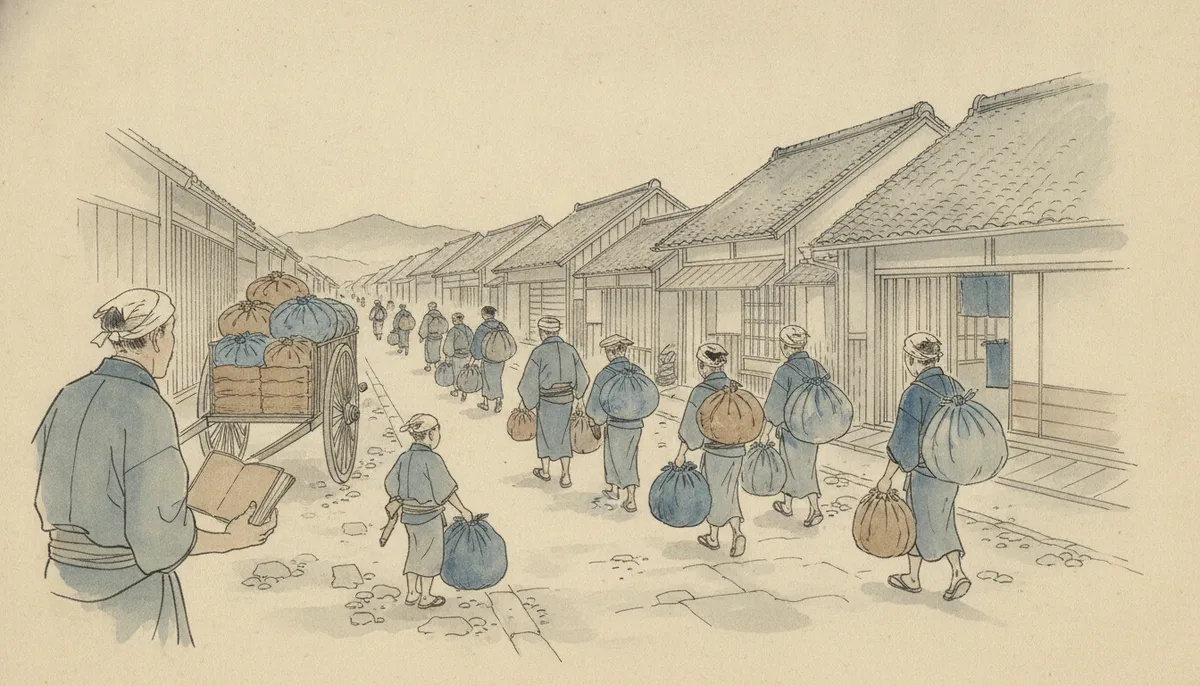
"Shall I wrap your load again, mister? With bolts of cloth you bring the corners together two by two, on the slant. Unless you lay the bolt slantwise in the middle, the corners won't stand up properly."
In the boy's hands my load came down to about half its bulk. The corners met on the slant, every corner stood up, and when I lifted it, the weight of the bolts settled evenly across my back. The smell of the indigo from the storehouse rose faintly from between the folds. The knot drew tight when pulled, and slipped loose at a push on its end. Impressed, I tried to tie it the same way. The second time it drew too tight; the third time it came undone and the bolts rolled onto the earthen floor. Mankichi, without a word, picked them up.
The spare cloth went off with Otama and did not come back. I wonder whether that flask is standing in a corner of the wedding feast. I did not feel sorry to lose it. Since that spring, before I wrap a load, I flick the corners of the cloth twice.
When I went back into the storehouse, Okuni had just set the last bolt on the shelf. Before any word of thanks, the mistress said:
"The head clerk came back just now. While you were in here, he settled things with some other peddler and went home."
Okuni knitted her brows as if sorry, but no word of apology came. She flicked one bead of the abacus, and then her hand stopped there.
The introduction fell through. Without my having chosen it, my earnings that day came to the dust of the bolts, the smell of sake, and splinters in my palms.
I laughed ruefully and strapped Mankichi's bundle on my back again. Mankichi was already out in the shop front, wrapping another customer's hand towel, flicking its corners twice first. When I went out, the rain had stopped. The western sky had split open, and the sun was shining. My feet, turned east, opposite the way I had come, were quickening of their own accord.
The knot was the same square knot as Mankichi's that day. What differed was the dyed pattern at the corner: in place of the Izutsuya's shop name, cherry petals were scattered. And the cloth was not the coarse weave of that cloth, but a slick synthetic. I saw it on a spring evening, in front of a station, at the door of a sweets shop.
A woman in the shop wrapped a box of freshly baked manju, steamed buns filled with sweet bean paste, in a furoshiki, and a customer took the handle.
Through the cloth, the warmth of the box passed into her palm.
Every tale is built on real scholarship. These are the Japanese-language works this one rests on — listed in full, so you can see exactly where the history ends and the story begins.
New tales are translated as they are written. Get each one — with a short note on the history behind it — by email.
 The Tales Only I Have Seen