— — Whose place was the bowl at the left end of the stall? — —
Edo, 1793 (Kansei 5) · 8 min read
New here? Why the narrator has been wandering for a thousand years is told in the Prologue.
A soba counter at the end of the year. A customer at the far seat holds his noodles up and does not bring them to his mouth, tracing the rim of the bowl with a finger in the steam. There is a small chip in the rim.
On New Year's Eve in 1793 (Kansei 5), from morning on, the debt collectors were running all over the streets of Edo. Head clerks dashed past with ledgers hugged to their chests, and from alley after alley came the thump of mochi being pounded. It was the day for settling what you owed before the year was out.
As for me, I was waiting at a town gate on the edge of town for someone to hire me for the day. A bent old man came up, looked me over sharply, and said:
"If your hands are free, come with me. My night-selling hand's gone down with a cold."
His name was Tomezō, a soba seller nearing seventy. When I gave my name, Yoichi, all he said was "Is that so," and then he walked on ahead without another word.
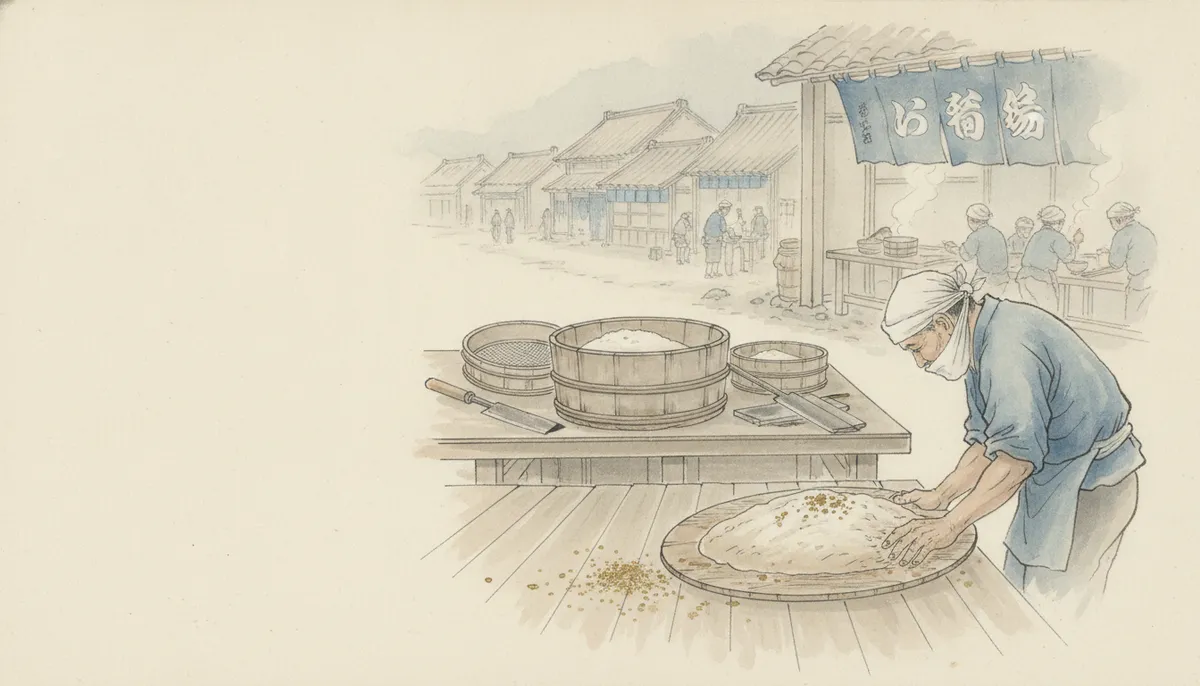
On the floor of his tenement kitchen, balls of soba dough kneaded earlier in the day sat in rows under damp cloths. You add the water to the flour in three goes, Tomezō's hands told me. Pour it all at once and the flour clots, and however long you knead it afterward, it will not cut fine. I was given the pressing to do, and again and again he made me test, with the heel of my palm, the weight of the dough as it came together. Tomezō folded the sheet he had rolled out thin on the board, pushed it over to me, and put a knife in my hand.
Cut it, that meant.
I cut as fine as I could, every strand the same width. Tomezō took the cut bundles into a bamboo strainer, and as they came, he pinched out only the thick ones and dropped them into a small bowl at his side. The bowl was soon a heap. He would eat them himself later, I supposed. Only the even, thin bundles went to the customers' bowls.
On an ordinary last day of the month it was eight bundles, Tomezō said. Tonight, sixteen. That was all he said, and then he fell silent again. The bundles piled up in the strainer one by one. Counting them, I understood that the one night of the year when the customers came twice as many was something he had been through dozens of times over.
Outside, the town was in the thick of its racket of squaring the year's accounts. A voice slashing prices on unsold New Year's straw decorations; a man chased by a collector ducking into an alley. Tomezō crossed that current without the least hurry, back bent. The heels of his sandals were worn right down.
As the day leaned toward evening, we shouldered the tenbin, the carrying pole. Pot and charcoal in the front box, bowls and strainer in the back. The weight biting into my shoulder was much harder to bear than I had expected.
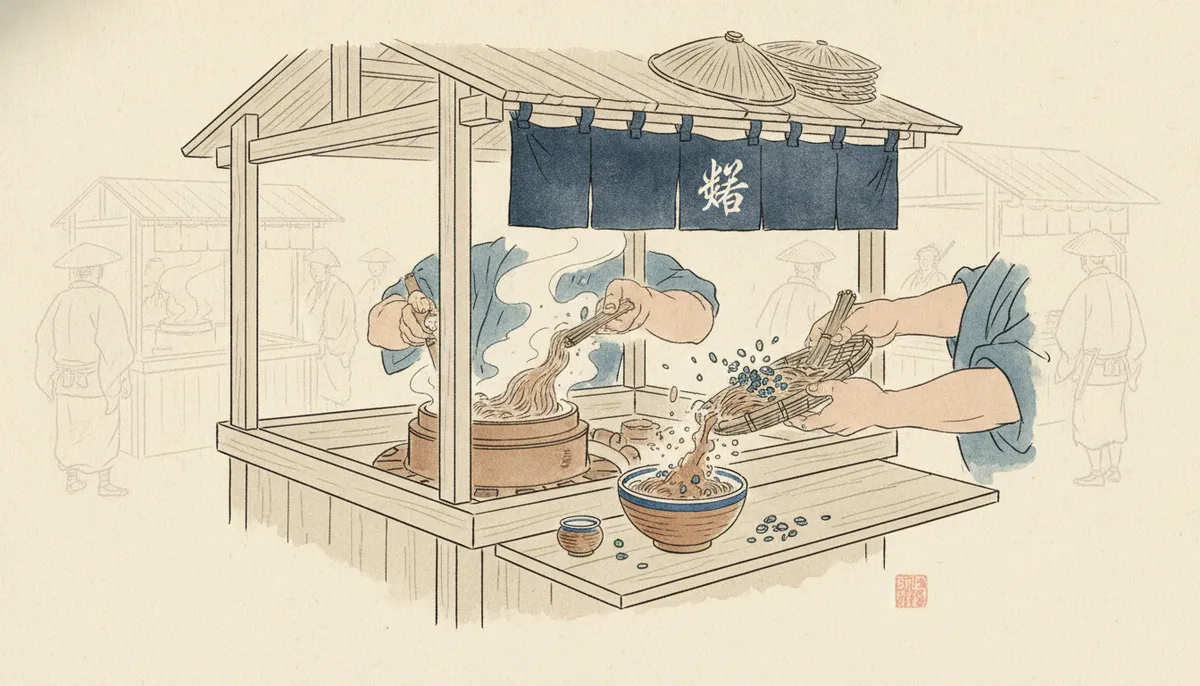
Where Tomezō stopped was a crossroads at the dead end of the wholesalers' street, in the shadow of an oil merchant's wall. The bright corner on the main street had already been claimed by other stalls. Here the wind came through and few people passed. Even so, Tomezō had me set down the load without a moment's doubt, and made me wait without lighting the paper lantern. For a while he stood with his nose turned toward the wind. Then he had me pull out the straw matting from the bottom of the load and hang it on the windward side. Only after I had heard the evening bell far off did he finally let me light the flame.
Getting the fire going under the pot and setting out the bowls was my job. When I had set out seven, Tomezō reached over and took one up. A bowl with a chipped rim. He wiped it with a cloth and set it face down at the left end of the stall. It was a bowl that never went out to a customer.
The first customers were junior clerks with bundles on their backs in wrapping cloths. After a day of running, their feet stopped in front of the pot. Taking their bowls, they all did the same: lifted the noodles high on their chopsticks, looked at them for a breath, and only then slurped.
"Thin and long, they say," said one.
The man next to him set down his bowl and laughed.
"I'm the opposite. I like that it breaks easy. This year's blunders, what I owe and what's owed me, I snap them off right here and cross over."
There were only six bowls. As customers finished, the bowls came back, and I rinsed each one quickly in the wash tub and set it by the pot again. The water went cold and muddy in no time, and my fingertips lost all feeling. Even so, the line of customers did not break.
A grey-streaked man wiped his face with a hand cloth in the steam. Fine flecks of gold glinted on the back of his hand. He said he beat gold leaf for a living. The fallen gold, he said, you pick up with a dumpling of kneaded buckwheat flour, patting it down, so if you eat soba, gold comes to you. He said it himself, and laughed at it himself.
Tomezō gave every customer the same bowl with the same movement of his hands. To the one who said thin and long, to the one who said cut, to the one who laughed about gold. Which of the wishes was the true one, he never said a word. He only watched the heat of the water in the pot, and counted the customers with his eyes.
When the customers had thinned out for a moment, Tomezō spoke through the steam from the pot. It was about the chipped bowl at the left end.
"Every month's end, the one who ate here was a wholesaler's head clerk."
At month's end you run all day collecting on credit. On the way back he would stop here, always standing at the left end, slurp down one bowl, let the strength drain from his shoulders, and go back to his shop, he said.
"Up to the end of last year, that is."
After that Tomezō said nothing more. Snow began to flicker down. The hung matting rattled in the wind. So that was why he had told me to hang it windward. The fire in the pot, behind the matting, did not so much as stir.
In a gap between customers, Tomezō pushed the small bowl at his side over toward me. The thick bundles he had picked out at midday. I took some hot water from the pot, boiled them on the spot, and slurped them standing. Uneven, the bite winning out. I learned from it that the thin ones are the ones that go smoothly down the throat.
A bell sounded once, far off, and then footsteps came around the corner of the crossroads. A young junior clerk. The wrapping cloth on his back was nearly empty; whether he had collected what could be collected or was carrying over what could not, his face did not say. Only his shoulders had dropped.
The clerk's eyes stopped on the chipped bowl at the left end.
Tomezō, without a word, turned the bowl upright and tossed soba into the pot. His hand draining the water was already reaching for the next strainer. The ladle of broth lay within my reach. I took hold of it and poured.
The clerk received the bowl in both hands. He stood at the left end, and before taking up his chopsticks, he first let the warmth of the bowl pass into his palms. Then he lifted the noodles and, saying nothing, slurped. With every zuru, zuru, the shoulders he had been holding pinched came loose. Before the light, his back eased by a good measure.
He handed the emptied bowl back into Tomezō's hand. He bowed his head once, hitched up his wrapping cloth, and went back into the dark street. Tomezō took the bowl and sank it in the wash tub.
Far off, a gooon, the night bell began to toll. Tomezō washed the chipped bowl, wiped it, and once more set it quietly face down at the left end. In the snow, the steam from the pot stood up whiter than ever.
Near dawn, I shouldered the pole again for the way back. It should have been lighter than on the way out, yet the same spot on my shoulder ached dully. On the floor of the tenement kitchen, Tomezō gave me uneven bundles wrapped in paper in place of wages. I tucked them into the load on the pole and set out through the town, where few people were about on the morning of New Year's Day, toward the next lodging. The lantern at the tenement door had long since gone out. Tomezō stood there still, seeing off my back.
Whenever I see the long lines that form in front of soba shops on New Year's Eve, I think of that seat at the left end, at that crossroads. The bowl slurped at each month's end grew deepest on the year's last one, and later came to be called toshikoshi soba, year-crossing soba, so I have heard. Ah, so it starts there, I thought, before the steam. The nostalgia I felt then stays at the back of my tongue even now.
When spring had come, I passed that crossroads once more. In the shadow of the oil merchant's wall, at the left end, a junior clerk was tipping up a bowl. His back, rounded in the steam.
Every tale is built on real scholarship. These are the Japanese-language works this one rests on — listed in full, so you can see exactly where the history ends and the story begins.
New tales are translated as they are written. Get each one — with a short note on the history behind it — by email.
 The Tales Only I Have Seen