— — What only Grandfather knew, on a hill where the cherry trees had been planted a little over ten years before — —
Edo (Asukayama), 1732 (Kyōhō 17) · 7 min read
New here? Why the narrator has been wandering for a thousand years is told in the Prologue.
At seven in the morning, in a park, there is a person setting cans of beer on the four corners of a blue sheet.
Overhead, the white of the Somei-Yoshino cherries. I watched those four cans for a good while.
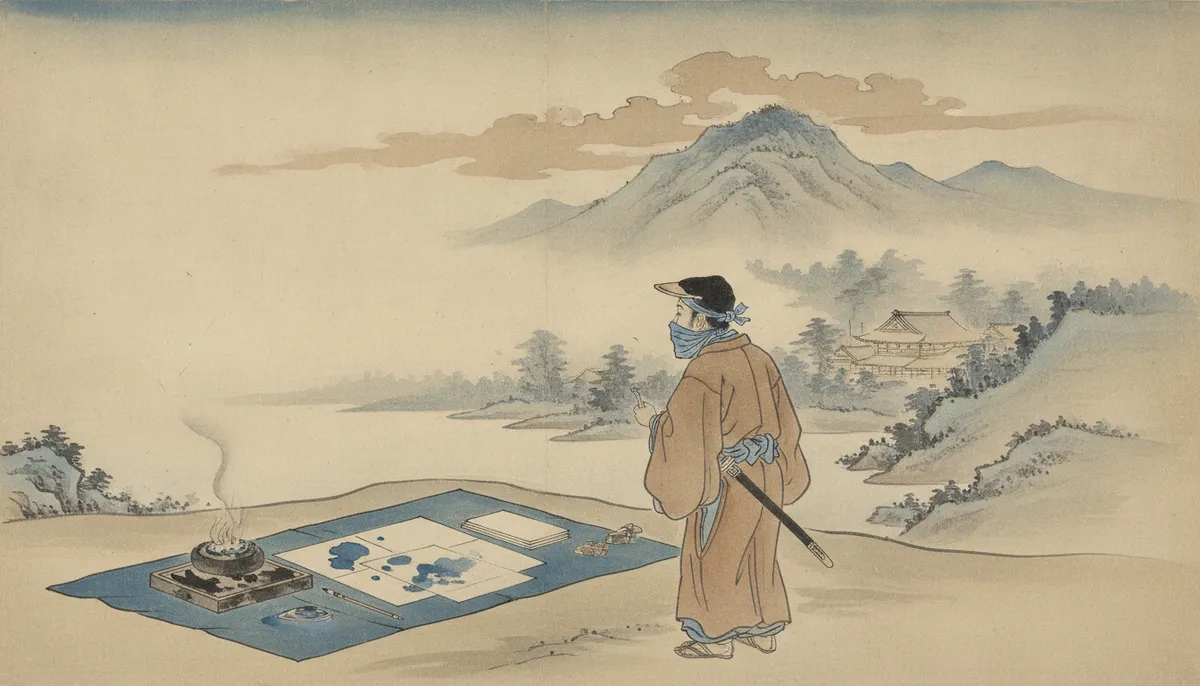
In the spring of 1732 (Kyōhō 17), on the road to Ōji, I saw cherry trees at the top of a hill at Asukayama and stopped. I sat down on a roadside stone and took off my hat.
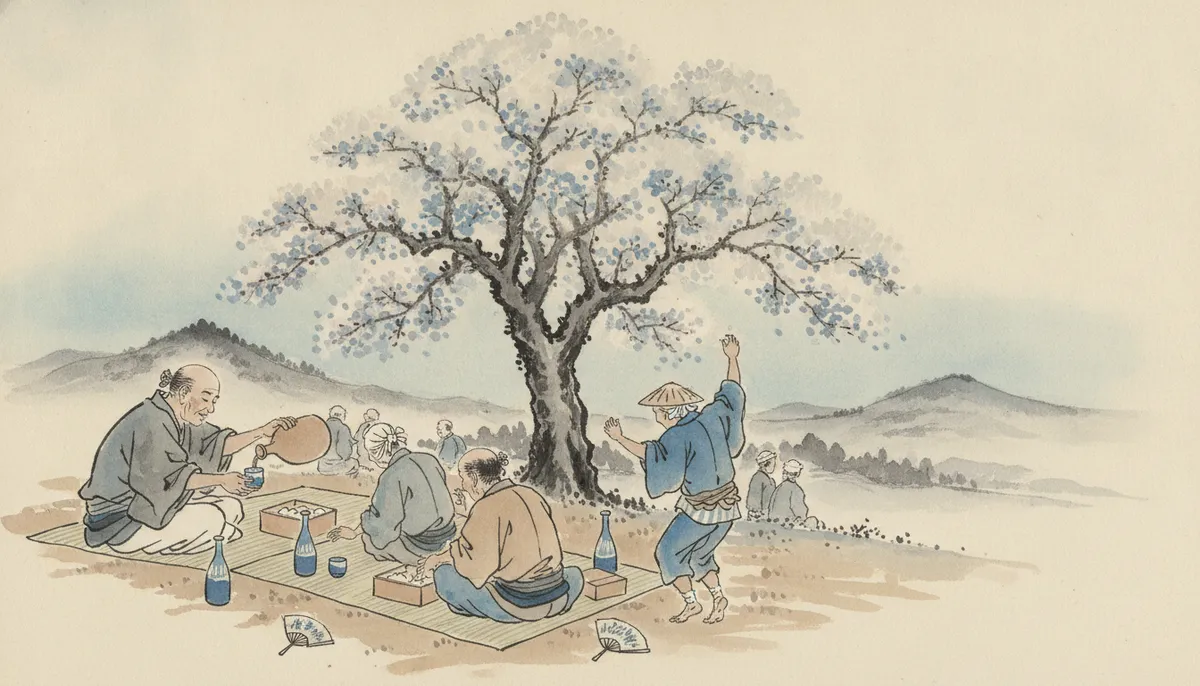
Looking about, I saw that the rugs and mats spread beneath the trees could be counted on one's fingers. A party of five or so, who seemed to be a village headman and his retainers, on a felt rug. A farming family from the neighborhood sitting in a ring on a straw mat, with pickled radish and a twist of mugikogashi, roasted barley flour, in the middle of it. A retired old man leaning alone against the foot of a tree, sipping sake, his face already faintly red while the sun stood high. One shamisen, the three-stringed lute, was sounding somewhere, and no one objected.
I had heard that, for cherry blossoms in Edo, the hill at Ueno was about all there was. It was the authorities, they say, who had cherry trees planted on this hill. A thousand or so, I was told, which is no small number. Some say it was their kindly wish that common people should have a place where they could view the blossoms in peace, but what the truth of it may be is not for me to know. And every one of them was a young tree, planted barely more than ten years ago. Most trunks were no thicker than my arm, and there was not one old tree, so far as I could see, that you could not have got both arms around. Even so, the branches were thick with blossom. The flowers were pale pink, and the reddish-brown young leaves had opened on the same branches beside them.
I unwrapped the rice ball I had brought, on my knee. The rice harvest the year before had not been good, I had heard. The rice ball had barley mixed in and was dark. On the headman's felt rug lacquered boxes were stacked three tiers high, and a tokkuri, a sake flask, was going round. I could hear the headman talking about the land tax. He kept his voice low, but it was hardly talk to have beneath blossoms. I bit into my barley-mixed rice. Beneath the blossoms, even that was not bad.
When I had finished eating, I walked a little way along the slope. The trunks of the young trees were slender, their bark marked with lines like horizontal stripes. Below, in the bottom of the valley, fields had opened out, and the yellow of the rape blossoms ran on like a sash. I went back to my stone and sat down again.
Toward the time the sun began to lean to the west, an old man went past along the edge of that sparsely peopled hill.
He walked with a stick and stopped now and then to catch his breath, but his step was firm. A man in his prime, who looked to be his son, shouldered a rolled-up felt rug, and the son's wife, carrying a bundle of lacquer boxes, followed after. There was no end of sunny open ground. The cool places beneath the trees were still free as well. The old man gave none of them so much as a glance and walked straight past.
He went on up to the very top of the slope, to a stretch of grass where a single thick zelkova stood, and there he stopped. It was an exposed spot, swept by the wind, poor in sun and poor in view. No one would choose such a place on purpose.
The old man was looking down the hill. Toward the valley, where the haze hung, narrowing his eyes, for a long time. I looked the same way myself. The haze was moving slowly toward us. That was all.
Then he looked at the foot of one tree. His son nodded and spread out the felt rug, its shorter side turned down the hill. Under the spread rug, four round hollows in the earth showed at the roots of the grass. They were the old marks of stones, dents the shape of stones. The son pulled the grass around the hollows and smoothed the ground.
The old man took a cloth bundle from his breast and opened it at the edge of the rug. Four black stones, each the size of a fist, every one rounded at its corners. One was worn flat on one side and was a size smaller than the other three. Without his son's help, he set them himself, one on each of the four corners of the rug. The stones dropped neatly into the four hollows. The cloth was carefully folded and went back into his breast. Before he set the last one down, he brushed the earth from it with his palm and turned its flat side down. The tips of his fingers were the color of soil.
A young servant from the headman's party saw this and whispered to his fellows: "Carrying stones to a flower-viewing? Is that grandpa's ballast?" His fellows laughed. The old man did not so much as look at him. He took up one of the rice balls his son and daughter-in-law had brought out. The son's wife portioned out some simmered vegetables onto a small plate and pushed it toward the old man. He chewed it slowly.
Perhaps half an hour went by. The branches at the top of the hill, every one, bent slowly upward. The clouds parted, the sun fell full on the cherry trees, and for an instant the color of the blossoms deepened. The shamisen had stopped, I did not know when. From below the hill, a wind came climbing.
The wind rattled the grass near the valley and then went on, up and up. The edge of the headman's felt rug lifted, the three-tiered boxes lost their lids and tilted, and simmered vegetables rolled out. One whole felt rug floated up and pasted itself flat against a tree trunk. The farmers' mat turned over, and two teacups went rolling over the grass. Hats flew, hand towels flew, and here and there people cried out. The retired old man hugged his flask in both arms and did not spill a single drop. Just as he was, he lay back at his ease and looked at the sky between the branches.
Whatever flew was carried up the hill, up and up. And every last piece of it came tumbling together just below the old man's rug. The reason was one even I could see. At the back of the rug stood that thick zelkova. High in its branches the newly opened leaves were stirring in the wind. Where the four stones held the edge of the rug down there lay a hat, three hand towels, one box lid, and two teacups.
The servant who had laughed came climbing the hill out of breath. The old man's son wiped the mud from each thing on his sleeve before handing them over, one by one, without a word. The servant took back his hat, held it to him, and went down the hill. A farmer's wife came up for her teacups as well; when she had taken them she pressed two twists of roasted barley flour into the son's hands and left. When he had finished his rice ball, the old man lifted one of the stones, checked the earth beneath it with his finger, and set it back in the same hollow.
The wind brought blossoms, too. Pale pink petals fell in small patters onto the rug. The very first of them settled on the old man's neck. He did not brush it away; he took another bite of his rice ball. His son's wife went to cover the petals fallen in the lacquer boxes with her sleeve, and stopped her hand. There was one on the fish cake, too. For a while the top of the hill rang with the voices of people picking up what had flown.
As the sun sank, the wind blew now and then from the same direction. Each time, the headman stopped his talk of the land tax and brushed the mud off his rug, the rug was spread again, and the farmers' mat turned over. On the old man's rug a thin layer of petals had gathered, forming a gentle border along the shadows of the stones. The yellow of the rape blossoms in the valley bottom was losing its color as the light went.
The headman's party folded their rug and, with a glance toward the old man's, went down the hill. The last ones left were the old man's rug and the retired man. When the sun was setting I tucked my leftover rice-ball wrapper into my sash, put my hat on again, and went down the hill, hurrying, so as to get there before dark. When I looked back, only the rug at the edge of the slope, in the evening light, lay bright, strewn all over with pale pink.
There was not one Somei-Yoshino on that hill. That white had not yet bloomed anywhere in this country.
It is said that Asukayama was opened wide to the townspeople and began to bustle five years after that. The hill of that day I remember as a quiet mountain where the wind passes through.
Cherries a little over ten years old. Four stones in four hollows. The very first petal on the old man's neck.
Every tale is built on real scholarship. These are the Japanese-language works this one rests on — listed in full, so you can see exactly where the history ends and the story begins.
New tales are translated as they are written. Get each one — with a short note on the history behind it — by email.
 The Tales Only I Have Seen