— — Why did the villagers stake their coins on a bitter brew? — —
Ōmi, 1432 (Eikyō 4) — Muromachi · 8 min read
New here? Why the narrator has been wandering for a thousand years is told in the Prologue.
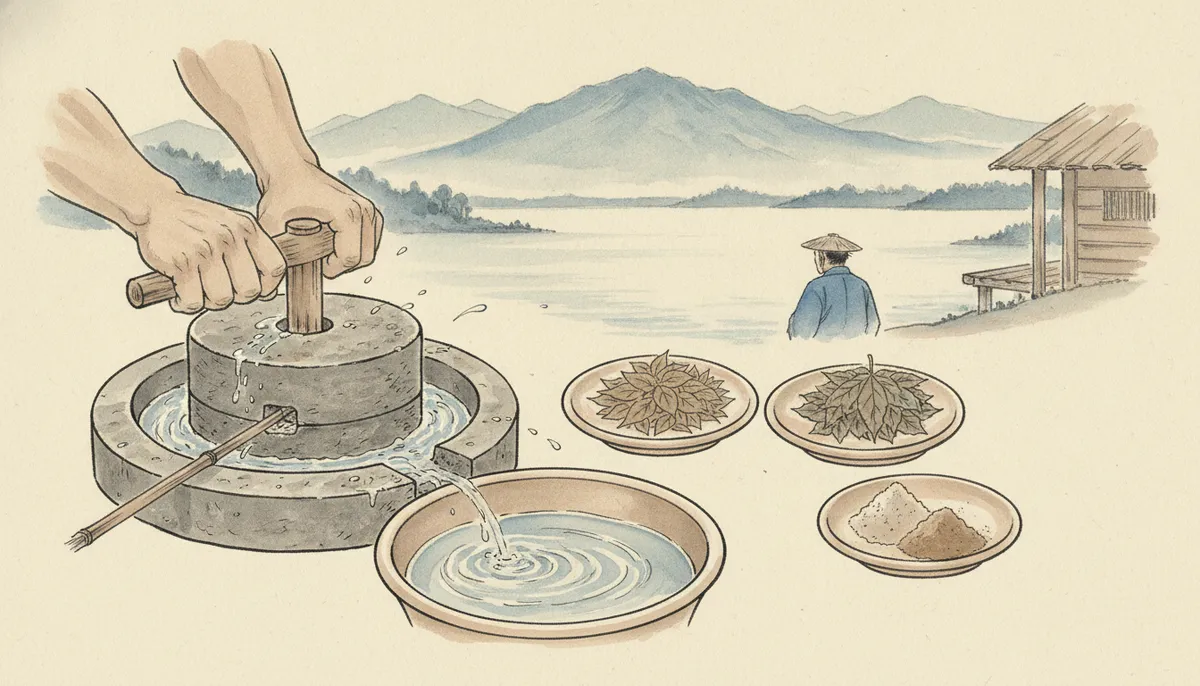
Green powder falls from the seam of the millstone in a thread. It falls into a black bowl. The grain is so fine that a breath would scatter it. The wooden handle has gone black and glossy with the grease of hands, and the one place where you grip it, the grain has worn round and smooth.
I once turned that handle for an hour, on the shore of the lake in Ōmi.
This was after tea had turned from a medicine into a pastime. A monk named Eisai had brought the seeds and the way of drinking it back from across the sea, and tea had come in first as medicine — so I had been taught. It drove off sleep, it settled the belly, they said. Some two hundred and forty years had gone by since. The tea I knew was leaves in a teapot, hot water poured over, and you waited. The tea of that day ran the other way round. I had heard of the wagering game called tōcha, "tea-guessing," by name. But knowing of it and putting your knee down in the circle were two quite different things. The villagers were not drinking it as medicine at all.
In the spring of 1432 (Eikyō 4), in a village on the shore of the lake in Ōmi, a traveling man called out to stop me. I had been walking along with paper and combs on my back, and my feet halted before a stall of reed screens at the village entrance.
Under the screens stood a stone mill, a cauldron, and a jar with a tight-fitting mouth. A man with a cloth wound round his head was tending the heat of the water in the cauldron.
"I'll feed you. I'm short of hands for the mill. Will you grind a batch?"
His name was Kurōta. He had come from around Toganoo, west of the capital, he said, with tea leaves on his back and the mill on a cart. By the way his sentences lifted at the ends, I could tell he was no villager. I leaned my pack against a post of the screens and took hold of the handle.
The upper stone was heavy. With each turn the weight settled into the joint of my arm. Kurōta took leaves out of the jar, steamed and dried, every stem plucked out, and when he rubbed them in his palm they rustled. He dropped them into the hole of the mill a pinch at a time.
"Slowly. Hurry, and the powder scorches. And what you grind, you use on the spot. Powder left standing is something else already."
As told, I kept my hand even on the pull. After about an hour, a green heap stood at the bottom of the bowl. My arm trembled. The glossy grain of the handle had bitten straight into my palm.
Meanwhile three or four villagers had drifted over. They all stood back a little and watched the cauldron and the mill.
"Tea, I've seen the priest at the temple boil it for the sick," said Shōhei, a man with a bent back. "A brown, bitter water. That's medicine. Grinding it to powder to drink — that's playing at being an apothecary."
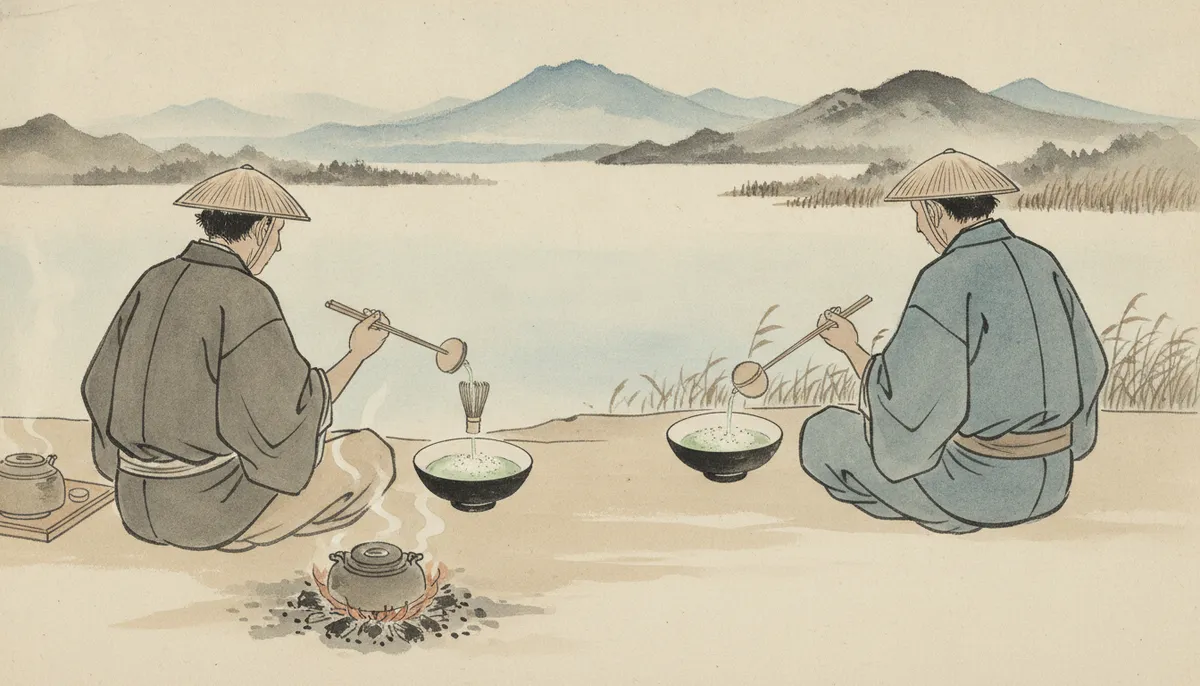
Kurōta did not answer. Wordlessly he rinsed a black bowl with hot water, dropped in a spoonful of powder, and poured a thin stream. He whisked with a little broom of finely split bamboo, from the wrist alone. Foam rose, and the surface of the bowl was covered over in pale green. He set it before Shōhei.
Shōhei looked at the bowl out of the corner of his eye and did not reach for it. A young man put his lips to it first and made a face, and drank a second mouthful all the same. After that he said nothing and stood holding the bowl.
I watched. Boil the leaves, or steep them in hot water. Those were the only two things tea could be, my body had taken for granted. This man's hands did neither. Rinse, drop, whisk. That was all, and the hot water had turned, without my noticing, into something to drink.
After noon Kurōta pushed the black bowl and the bamboo whisk toward me. "You try whisking." I dropped in the powder, poured the water, gripped the whisk. Turned with all my strength, the foam came up big and coarse, and sank at once. Kurōta did not take my wrist. He lifted his own bowl to the height of my eyes and whisked it for me to see. Only the wrist moved, finely; the elbow not at all. Again. This time the foam gathered fine across the surface of the bowl and held a little. "That'll do. The rest is a matter of doing it many times." A young man, one of Shōhei's companions, peered in from behind. "This fellow's from the capital, isn't he. Who'd buy tea from him around here? If it's medicine, you get it from the temple, and that's enough." Kurōta laughed, and said neither yes nor no. I did not cut in either. To the villagers, tea brought by an outsider was something to doubt first. All I did was keep the fire under the cauldron from dying.
That evening Kurōta set three bowls in a row before Shōhei.
"One is the true tea of Toganoo. The other two are leaves from the hill south of this village and the hill north of it. Whoever picks out the true tea takes every coin that's out on the floor. Whoever misses leaves his stake behind."
So this is tōcha, I thought. A wagering game in which you name by tongue the honcha, the "true tea," from among the hicha, the "not-tea," all the rest.
Turning the mill was my job again. For each of the three leaves, Kurōta had me wash the mill well with water. "If they mix, guessing is no use." I scraped the powder from the grain of the stone with a bamboo skewer. The water had the cold of a spring lake, and my hands went numb. For a while the tips of my fingers did not feel my own. The south hill's leaf was light, the north hill's rather thicker. Even the color of the powder differed, ever so slightly.
That night, on the board floor of the lodging, seven or eight men sat in a ring. The cauldron in the middle hissed and gave off steam. Shōhei was in the circle too. Arms folded, he had taken the seat at the far end.
Kurōta whisked the foam, and the bowls went round in turn. I too ran my fingers over the coins at the bottom of my pouch, counting, and set one down. I pulled the mouth of the pouch tight again before I joined the circle.
The first bowl. Bitter, but a sweetness lingered after. The second. The bitterness sharp, pricking the tongue. The third. A good scent, but a thin aftertaste.
The first bowl, the sweet one, must be the finest, I thought. My body said so. I pointed to the first bowl.
Kurōta silently opened the paper packet. The first bowl was the leaf from the hill south of the village.
My coin flowed away to the front of the man beside me. At that moment Kurōta looked at my face and lifted the corner of his mouth, just slightly. That was all.
One of the young men took the second bowl and tilted his head. "They all taste of tea. My tongue can't tell." Laughter broke out, and someone asked, "Is there anyone in the capital who can tell them apart?" Kurōta, sinking a ladle into the hot water of the cauldron, answered only, "There is. People who've been drinking tea and telling it apart for decades."
Shōhei took the second bowl. He rolled it on his tongue, closed his eyes, rolled it again.
"This isn't the north hill's. Afterward, it comes up slowly, heavy."
Kurōta opened the packet. The second bowl was the true tea.
Shōhei's brow moved. For the first time his eyes were not on Kurōta's hands but on the bottom of the bowl. Then he looked around the men in the circle and said, "Once more. Let me go again."
One more round, then another, and the coins went back and forth. Those who guessed right slapped their knees; those who missed looked up at the ceiling. When the water in the cauldron ran low, Shōhei got up himself to add more. This was the man who, earlier, had not reached for the bowl.
Toward daybreak, somewhere in the ring, talk of how to divide the water for the rice paddies came up. Someone passed a bowl, a word or two was exchanged, and by the time it was done the matter was settled. Few of the faces looked sleepy.
A young man in the corner dozed off and knocked his forehead against the rim of a bowl. Everyone laughed, and the laughter woke him, and he went on into the next round. Kurōta did not join the ring. He stayed by the cauldron, adding water when it ran low and whisking again when the foam collapsed. Even so, everyone, as they handed on a bowl, watched his hands.
As for me, I lost three times at the wagering and won once. I won on the third round, by not choosing the sweet one but the one that came up slowly, heavy afterward. A guess like an imitation, made after watching Shōhei's tongue.
Next morning Kurōta was about to load the mill onto the cart. I lifted the upper stone. The muscles of my arm still remembered yesterday's hour.
Shōhei had come over and was standing by the cart. He said nothing. He only held out one of the washed bowls, wrapped in a cloth, to Kurōta. Kurōta took it and set it on top of the load. In the morning light, down to the chips in its rim, the black bowl could be seen.
"Here."
Kurōta pressed three coins into my hand, and left one jar at Shōhei's house. He would come again, he said, the next spring. I shouldered my pack once more and went west along the shore of the lake.
That green powder was made by turning a heavy stone for an hour. The bowl came to me in both hands, and its heat and weight reached my wrists.
Tea today drops into the bowl with the ease of twisting the lid off a can.
Every tale is built on real scholarship. These are the Japanese-language works this one rests on — listed in full, so you can see exactly where the history ends and the story begins.
New tales are translated as they are written. Get each one — with a short note on the history behind it — by email.
 The Tales Only I Have Seen